



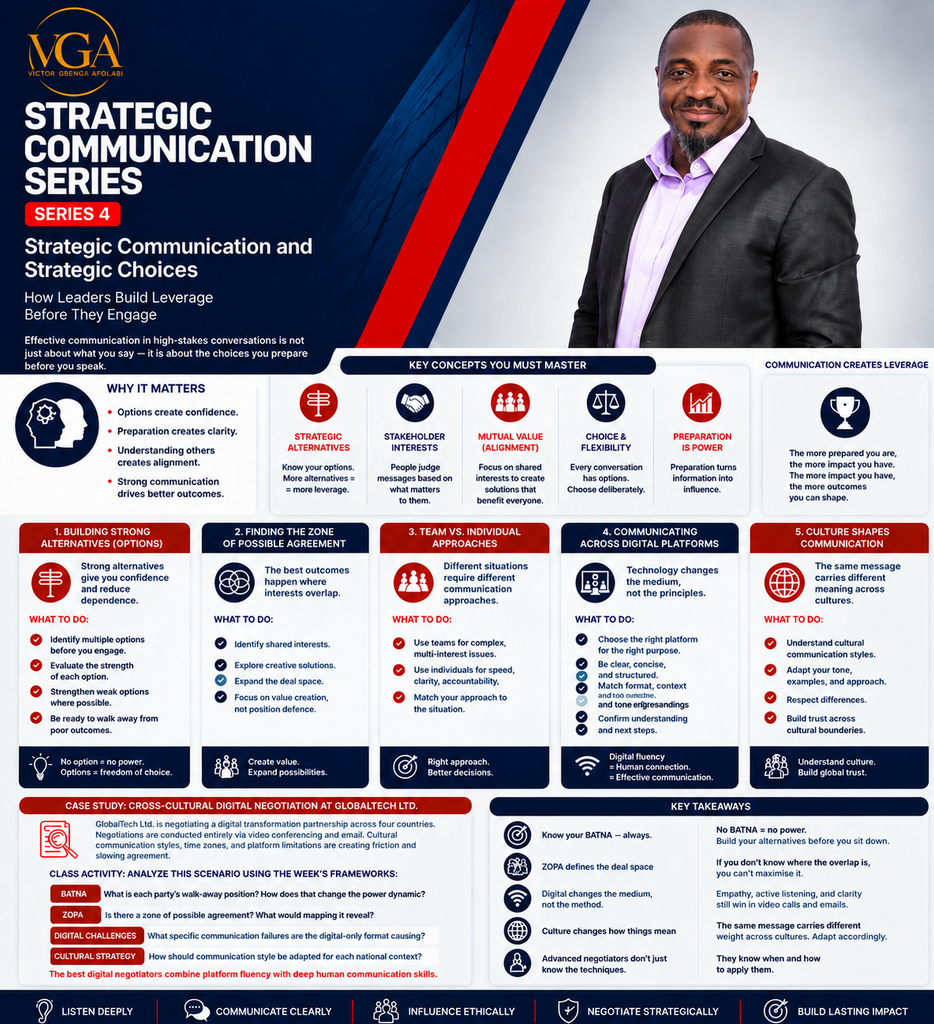
Strategic communication does not begin when a conversation starts.
It begins before the conversation.
Before leaders communicate a vision, make a request, influence a stakeholder, manage a difficult discussion, or pursue a strategic objective, they must first understand their position, their alternatives, and the choices available to them.
Many communication failures happen because people enter important conversations without preparation.
They know what they want to say.
But they do not understand what options they have.
They understand their own objectives.
But they do not understand the interests of others.
They focus on the immediate conversation.
But they have not considered the broader strategic outcome.
This is why strategic communication requires more than strong expression.
It requires strategic thinking.
Strategy Begins With Knowing Your Options
One of the greatest sources of confidence in communication is having options.
When leaders have only one possible path, their communication becomes dependent.
They communicate from a position of urgency.
They may compromise too quickly.
They may accept outcomes that do not support their long-term objectives.
However, when leaders understand their alternatives, they communicate from a position of strength.
Alternatives create flexibility.
They create confidence.
They allow leaders to make decisions based on strategy rather than pressure.
In strategic communication, the question is not only:
“What do we want to achieve?”
The question is also:
“What options exist if our preferred outcome does not happen?”
Strong leaders do not prepare only for agreement.
They prepare for possibilities.
Preparation Creates Communication Advantage
Great communication is rarely spontaneous.
Behind every effective strategic conversation is preparation.
Leaders must understand:
- What outcome are we trying to achieve?
- Who are the stakeholders involved?
- What matters to them?
- What concerns may they have?
- What information will influence their decision?
- What alternatives exist?
- What risks should be considered?
Preparation improves communication because it allows leaders to enter conversations with clarity.
Without preparation, people often react.
With preparation, people respond strategically.
The difference between reaction and response is one of the defining characteristics of effective leadership communication.
Understanding Stakeholder Interests Creates Alignment
Strategic communication is not only about presenting your position.
It is about understanding the positions, interests, and motivations of others.
Different stakeholders often want different things.
A customer may prioritise reliability.
An investor may prioritise growth and sustainability.
An employee may prioritise stability and opportunity.
A partner may prioritise value creation and trust.
The same message may not influence all stakeholders equally because people evaluate communication through their own priorities.
This is why strategic communicators ask:
- What does this stakeholder value?
- What problem are they trying to solve?
- What outcome matters most to them?
- Where do our interests overlap?
- Where do we need to create understanding?
Communication becomes more effective when leaders move beyond stating what they want and begin understanding what others need.
Finding the Space for Mutual Value
Successful communication is rarely about one side winning and another side losing.
The strongest strategic outcomes are often created in the space where different interests overlap.
Leaders must identify:
- Where can value be created?
- What shared objectives exist?
- What adjustments can improve alignment?
- What solutions create benefits beyond the immediate discussion?
This requires creativity.
It requires listening.
It requires the ability to see beyond fixed positions.
A stakeholder may reject an initial proposal but accept a different approach that addresses their underlying concern.
Strategic communication therefore requires flexibility.
The objective is not simply to defend a position.
The objective is to create movement toward a valuable outcome.
The Power of Strategic Alternatives
Strong alternatives create confidence.
They reduce dependence.
They improve decision quality.
They also influence how leaders communicate.
A leader with alternatives can ask better questions.
They can evaluate opportunities more carefully.
They can walk away from outcomes that do not support their strategic direction.
This does not mean rejecting collaboration.
It means entering conversations with clarity.
The strongest leaders are not those who must always win every conversation.
They are those who understand when to engage, when to adapt, and when to pursue another path.
Strategic communication requires knowing that every conversation is part of a larger strategy.
Communication Across Digital Platforms Requires New Discipline
The modern leader communicates across multiple platforms.
Meetings.
Emails.
Video conferences.
Collaboration tools.
Digital communities.
Social platforms.
While technology has changed the medium, it has not changed the fundamentals of effective communication.
Trust still matters.
Clarity still matters.
Empathy still matters.
Understanding still matters.
Digital communication creates new challenges.
Tone can be misunderstood.
Context can be lost.
Cultural differences can become more visible.
Information can move faster than understanding.
Therefore, leaders must become more intentional.
A message sent through a digital platform still carries signals.
The question remains:
What are people understanding from what we communicate?
Culture Changes How Communication Is Received
The same message can create different reactions depending on the cultural context.
Communication styles differ.
Some environments value directness.
Others value relationship-building before decisions.
Some stakeholders expect detailed explanations.
Others prefer concise conclusions.
Strategic communicators understand that effectiveness is not only about delivering a message.
It is about delivering it in a way that connects with the audience receiving it.
The responsibility of the communicator is not simply to speak clearly.
It is to ensure understanding.
Team Communication and Individual Communication
Different situations require different communication approaches.
Some strategic decisions require diverse teams because complexity demands multiple perspectives.
Teams bring:
- Different expertise
- Broader analysis
- Shared responsibility
- Stronger problem-solving capability
However, individual communication can sometimes provide speed, clarity, and direct accountability.
The important question is not whether teams or individuals are better.
The question is:
What does the situation require?
Strategic leaders know when collaboration creates better outcomes and when decisive individual action is necessary.
Technology Supports Communication, But Humans Create Outcomes
Digital tools can improve communication.
They can increase access.
Improve collaboration.
Support decision-making.
Create transparency.
But technology alone does not create strategic alignment.
A video meeting does not create trust.
A collaboration platform does not create understanding.
A digital document does not create commitment.
People create those outcomes.
Technology supports communication.
Human judgement gives communication meaning.
The strongest leaders combine digital capability with emotional intelligence.
Strategic Communication Requires the Ability to Choose
Every communication decision involves choices.
What should be said?
What should not be said?
Who needs to hear it?
When should it be communicated?
Which channel is most effective?
What outcome are we trying to create?
Strategic communication is therefore not simply the ability to communicate.
It is the ability to make deliberate communication choices.
Strategic Takeaway
The strongest communicators are not simply those who speak well.
They are those who think strategically before they speak.
They understand their objectives.
They understand their stakeholders.
They understand their alternatives.
They understand the environment.
They understand that every conversation contributes to a larger strategic direction.
Before leaders attempt to influence others, they must first understand their own position.
Because communication without strategy becomes conversation.
But communication guided by strategy becomes leadership.
Every message sends a signal.
Every signal shapes perception.
Every perception influences action.
And every action contributes to the future leaders are trying to create.