



Economic participation has historically depended on access to physical systems.
Access to banks, business networks, marketplaces, education institutions, and formal employment structures often determined who could participate effectively in the economy.
However, digital technology is changing how economic participation is created.
Today, a person’s ability to access opportunity is increasingly influenced by their connection to digital platforms.
Mobile payments allow small businesses to transact beyond cash limitations.
E-commerce platforms connect entrepreneurs to wider markets.
Digital learning platforms provide access to skills development.
Health technology platforms improve access to essential services.
Artificial intelligence is creating new opportunities for productivity and problem-solving.
The broader shift is clear:
Digital platforms are becoming economic infrastructure.
They are not simply tools for convenience. They are systems that determine how effectively individuals and businesses can participate in modern economies.
The Underserved Economy: A Question of Access and Connection
Across many emerging markets, millions of individuals and small businesses are economically active but remain disconnected from the systems that enable growth.
A small trader may have customers but lack digital payment options.
A skilled worker may have capability but lack access to online opportunities.
A farmer may produce valuable goods but lack market information and distribution channels.
An entrepreneur may have a viable idea but lack access to finance, training, or business networks.
The challenge is not always a lack of economic potential.
The challenge is the absence of connecting infrastructure.
Digital platforms address this gap by creating pathways between people and the systems they need to participate more effectively.
Digital Identity: Creating Economic Recognition
One of the foundations of digital inclusion is digital identity.
In traditional economic systems, many individuals struggle to access opportunities because they lack formal recognition.
Without identity systems, people may face difficulties accessing:
- Financial services
- Government programmes
- Employment opportunities
- Business platforms
- Digital transactions
Digital identity creates a foundation for participation.
It allows individuals to become visible within economic systems while enabling institutions to provide services more efficiently.
A person who was previously excluded from formal systems can now become connected to opportunities that were previously inaccessible.
Mobile Access: Expanding Economic Participation
Mobile technology has become one of the most powerful drivers of inclusion.
For many underserved communities, mobile devices represent the primary connection to the digital economy.
Through mobile platforms, individuals can:
- Access financial services
- Receive payments
- Learn new skills
- Find market opportunities
- Connect with customers
- Access information
The significance of mobile access is not only technological.
It is economic.
It reduces geographical barriers and allows more people to participate in economic activities regardless of location.
Digital Payments: Moving Beyond Cash-Based Economies
Digital payments have transformed how businesses and individuals exchange value.
For small businesses, digital payment systems create opportunities to:
- Accept more customers
- Maintain transaction records
- Build financial histories
- Access formal financial services
For individuals, digital payments provide safer and more efficient ways to participate in economic activity.
However, the impact of digital payments goes beyond transactions.
Transaction data can help create visibility for businesses that were previously invisible to formal financial systems.
This can improve access to credit, insurance, and other financial solutions.
E-Commerce: Connecting Small Businesses to Larger Markets
Many small businesses are limited not by their ability to produce, but by their ability to reach customers.
Traditional market structures often restrict businesses to their immediate geography.
Digital marketplaces change this equation.
E-commerce platforms allow entrepreneurs to:
- Reach wider customer groups
- Reduce distribution barriers
- Compete beyond local markets
- Build stronger customer relationships
This creates a more connected economy where smaller businesses can participate in larger value chains.
The opportunity is not simply selling online.
The opportunity is expanding economic reach.
Digital Skills and AI: Increasing Productivity
Access to technology alone does not guarantee inclusion.
People must also have the skills required to use digital tools effectively.
Digital literacy, online training platforms, and artificial intelligence tools are becoming increasingly important in building economic capability.
A worker with digital skills can access new employment opportunities.
A business owner using AI tools can improve efficiency.
A student with online learning access can develop capabilities beyond traditional limitations.
The future of inclusion will depend not only on connecting people to technology but ensuring they have the ability to convert technology into productivity.
Healthtech and Edtech: Digital Solutions for Essential Services
Economic participation depends on more than financial access.
People also require access to healthcare and education.
Health technology platforms are improving how individuals access medical information, consultations, and health services.
Education technology platforms are expanding access to learning opportunities, especially for people who may be limited by geography or traditional systems.
These platforms strengthen economic inclusion because healthier and more skilled populations are better positioned to contribute productively.
The Key Insight: Digital Inclusion Must Create Economic Value
A common misunderstanding is that digital inclusion simply means providing internet access or digital devices.
While connectivity is important, it is only the foundation.
The real objective is economic participation.
A successful digital inclusion system should enable people to:
- Access opportunities
- Build skills
- Create income
- Grow businesses
- Participate in markets
- Improve productivity
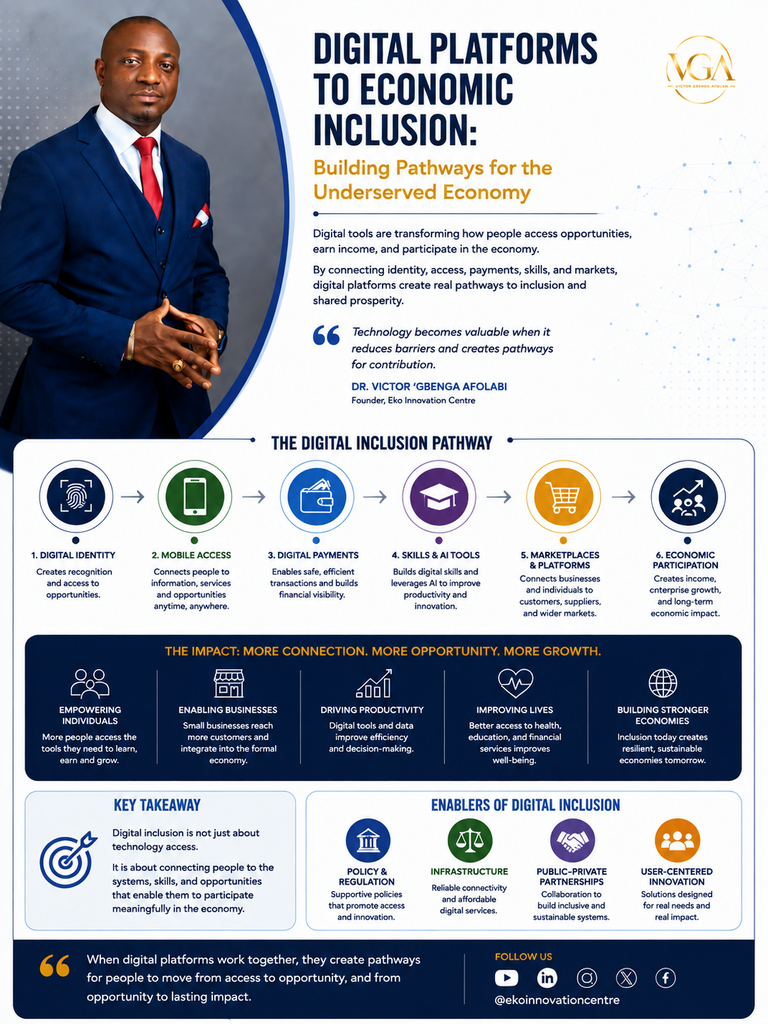
Technology becomes valuable when it reduces barriers and creates pathways for contribution.
Building an Integrated Digital Inclusion Ecosystem
Digital inclusion cannot be achieved through isolated solutions.
The strongest impact comes when different systems work together.
A complete digital inclusion pathway looks like this:
Digital Identity
↓
Creates recognition and access
Mobile Access
↓
Connects people to digital services
Digital Payments
↓
Enables economic transactions
Skills Development & AI Tools
↓
Improves productivity and capability
Marketplaces & Platforms
↓
Connect people to customers and opportunities
Economic Participation
↓
Creates income, enterprise growth, and productivity
This ecosystem approach transforms technology from a convenience tool into economic infrastructure.
Practical Implications for Businesses and Policymakers
For policymakers, digital inclusion should be viewed as an economic development strategy rather than only a technology initiative.
The goal should be creating systems where digital access translates into employment, enterprise growth, and productivity.
For businesses, digital platforms create opportunities to reach underserved markets, improve efficiency, and build stronger customer relationships.
For technology providers, the focus should move beyond building platforms toward solving real economic challenges.
The question is not simply:
“How many people are connected digitally?”
The more important question is:
“How many people are using digital systems to improve their economic position?”
Conclusion
Digital platforms are reshaping how economies create participation.
They are reducing barriers between individuals, businesses, and opportunities.
However, the true value of digital transformation is not measured by technology adoption alone.
It is measured by the economic outcomes created.
When digital identity, mobile access, payments, skills, marketplaces, and intelligent technologies work together, they create pathways for underserved populations to participate more effectively in the economy.
Digital inclusion is therefore not just about connecting people to technology. It is about connecting people to opportunity.