




For many years, economic inclusion has been viewed primarily as a social responsibility agenda.
Companies have often approached underserved communities through the lens of corporate social responsibility (CSR), philanthropy, or community support.
While these efforts create value, they represent only one dimension of the opportunity.
A deeper business reality is emerging:
Economic inclusion is not only a responsibility. It is a market strategy.
Across emerging economies, millions of consumers, small businesses, informal workers, and entrepreneurs remain outside traditional markets, not because they lack demand, but because existing systems were not designed around their realities.
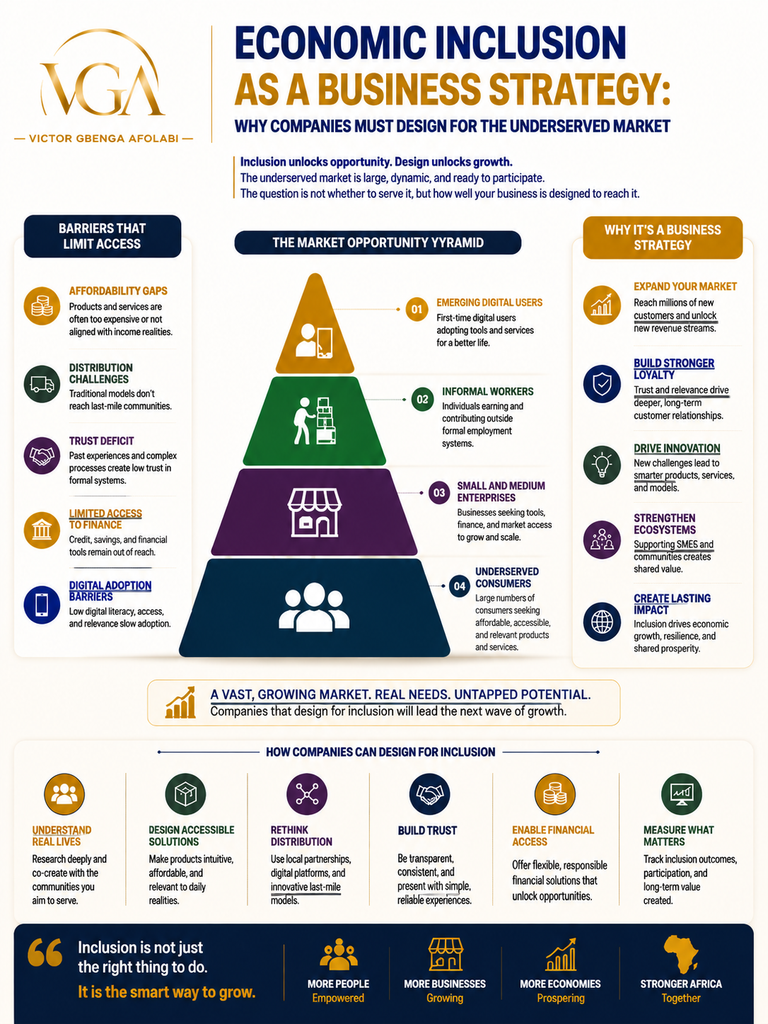
They face barriers such as:
- Limited access to affordable products and services
- Poor distribution networks
- Lack of trust in formal systems
- Limited access to finance
- Digital adoption challenges
- Products that do not reflect their income patterns or needs
For businesses, this represents more than a social challenge.
It represents a significant market opportunity.
The companies that understand how to design for underserved markets will not only expand access. They will unlock new customers, build stronger ecosystems, and create sustainable growth.
The Underserved Market Is Not a Small Market
A common misconception is that underserved consumers represent a low-value segment.
This assumption often leads businesses to overlook a large economic opportunity.
Underserved markets include:
- Informal workers
- Small business owners
- Emerging digital users
- Low-to-middle-income consumers
- Rural and semi-urban communities
These groups already participate in economic activity.
They buy products, run businesses, provide services, and create value.
The challenge is not the absence of demand.
The challenge is that many products, services, and business models are not designed to meet their realities.
Businesses that solve this design challenge can access large and growing markets.
Moving From CSR Thinking to Market Strategy
The traditional CSR approach asks:
“How can businesses support underserved communities?”
A market strategy asks a different question:
“How can businesses design solutions that enable underserved communities to participate more effectively?”
This shift changes the role of inclusion.
Instead of seeing underserved populations only as beneficiaries, businesses begin to see them as customers, partners, suppliers, and economic participants.
This requires companies to rethink:
- Product design
- Pricing structures
- Distribution models
- Customer engagement
- Financial accessibility
- Trust-building mechanisms
Inclusion becomes part of business growth rather than an activity separate from it.
Designing Products Around Real Consumer Needs
Many businesses fail to reach underserved markets because they design products based on assumptions rather than realities.
A product may be valuable, but still inaccessible because:
- The pricing does not match customer income patterns
- The payment structure is too rigid
- The product requires digital skills customers do not have
- The distribution model does not reach the customer
- The trust required to adopt the product has not been built
Successful inclusion requires customer understanding.
Companies must study how people earn, spend, save, and make decisions.
The strongest solutions are not created by lowering standards.
They are created by designing better systems.
Affordability: Creating Access Without Reducing Value
Affordability is one of the biggest factors influencing market participation.
However, affordability does not simply mean making products cheaper.
It requires understanding the economic realities of customers.
Businesses can create affordability through:
- Flexible payment structures
- Smaller product units
- Subscription models
- Asset financing solutions
- Digital payment options
The goal is not only reducing cost.
The goal is creating pathways that allow more people to access valuable products and services.
Distribution and Last-Mile Access
A major barrier in underserved markets is not demand.
It is access.
Many businesses struggle to reach customers because distribution systems are designed around major cities and established markets.
Last-mile access requires businesses to rethink how products and services move.
This may involve:
- Local partnerships
- Digital platforms
- Community-based networks
- Mobile delivery systems
- Agent models
The companies that solve distribution challenges will have a significant advantage because they can reach customers competitors overlook.
Trust as a Competitive Advantage
Trust is one of the most important elements of economic inclusion.
Many underserved consumers have limited interaction with formal institutions because previous systems may have been difficult to access or understand.
Building trust requires:
- Transparency
- Consistent service delivery
- Simple processes
- Local understanding
- Reliable customer support
Trust is not simply a social factor.
It is a business asset.
Companies that build trust within underserved communities create stronger customer relationships and long-term market loyalty.
The Role of SMEs and Informal Businesses
Small businesses and informal workers represent a significant part of many economies.
However, many remain disconnected from formal systems that support growth.
Businesses can create inclusion by designing solutions that help SMEs:
- Access finance
- Improve productivity
- Adopt technology
- Reach customers
- Strengthen operations
When SMEs grow, they create employment, increase economic activity, and strengthen local markets.
Supporting underserved businesses is therefore not only about helping individuals.
It is about strengthening the wider economic ecosystem.
The Market Opportunity Pyramid
Economic inclusion creates opportunities across multiple layers of the market:
Emerging Digital Users
People adopting digital tools and services for the first time.
↓
Informal Workers
Individuals creating economic value outside traditional systems.
↓
Small and Medium Enterprises
Businesses seeking tools, finance, and market access to scale.
↓
Underserved Consumers
Customers seeking affordable, accessible solutions.
At each level, businesses have opportunities to create value by removing barriers.
Analytical Insight: Inclusion Is a Growth Engine
The biggest misunderstanding about economic inclusion is that it reduces business profitability.
In reality, inclusion can expand markets.
When companies design for underserved customers, they often discover:
- New revenue opportunities
- Stronger customer relationships
- More resilient business models
- Improved innovation capabilities
The businesses of the future will not only compete for existing customers.
They will create systems that bring new participants into the market.
Practical Implications for Businesses
Companies seeking to design for underserved markets should consider:
1. Understand the customer reality
Move beyond assumptions and study how customers actually live, work, and make decisions.
2. Design for accessibility
Products must consider affordability, usability, and distribution.
3. Build trust intentionally
Trust should be treated as a core business strategy.
4. Use technology as an enabler
Digital tools should reduce barriers and improve access.
5. Measure participation, not only sales
The goal is not only customer acquisition but meaningful economic engagement.
Conclusion
Economic inclusion is increasingly becoming a business strategy.
The underserved market is not defined by a lack of value. It is defined by systems that have not fully enabled participation.
Companies that redesign products, services, and distribution models around these realities will discover new opportunities for growth.
The future of business growth will belong to organisations that can do more than reach existing markets.
It will belong to those that can create access, build trust, and design solutions that allow more people to participate in the economy.
Economic inclusion is not only about expanding opportunity.
It is about expanding the market itself.
Communication is one of the most powerful tools available to leaders.
Through communication, leaders create alignment, build relationships, influence decisions, manage expectations, and shape how stakeholders understand the direction of an organisation.
But influence without ethics becomes dangerous.
The ability to persuade people does not automatically mean that the outcome created is sustainable.
A leader may win attention through exaggeration.
An organisation may attract support through carefully designed messaging.
A company may present itself as responsible through public statements.
But if those messages are not supported by truth, transparency, and consistent action, trust eventually declines.
This is why strategic communication must always be connected to ethics.
Because the goal of communication is not simply to influence people.
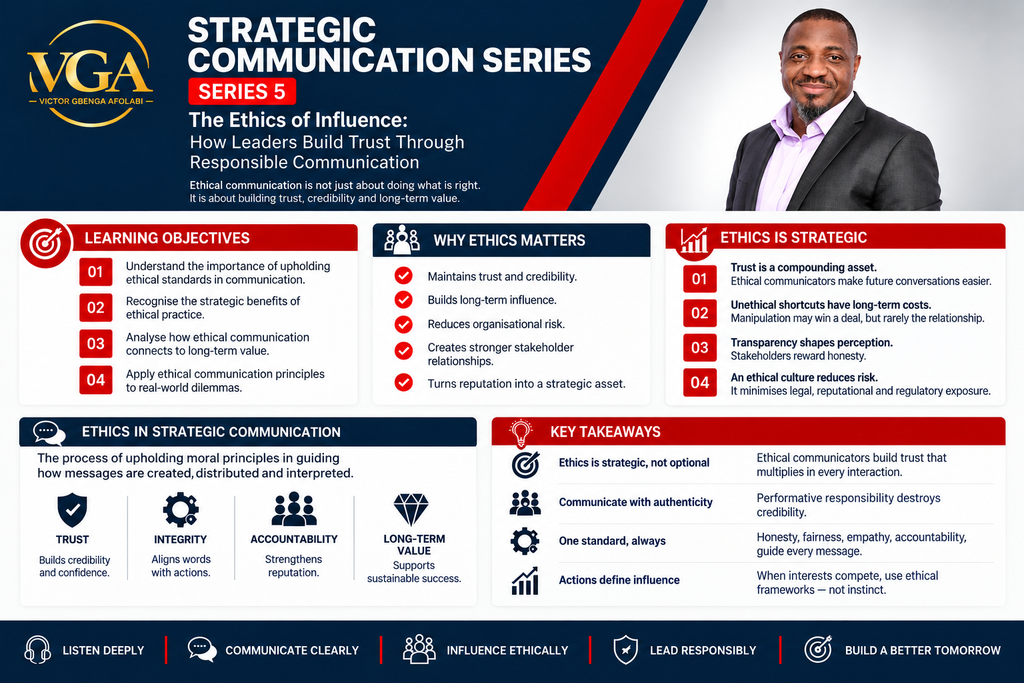
The goal is to influence people in a way that creates trust, credibility, and long-term value.
Ethics Is the Foundation of Strategic Communication
Strategic communication is built on one essential asset:
Trust.
Without trust, even the strongest message loses power.
Stakeholders may listen, but they will question.
They may engage, but they will hesitate.
They may participate, but they will remain uncertain.
Ethical communication strengthens trust because it demonstrates that the organisation respects the people it communicates with.
It means being intentional about:
What information is shared.
How information is presented.
What commitments are made.
How stakeholders are treated.
What actions follow the message.
Ethics is therefore not simply about doing what is morally correct.
It is also about protecting the foundation upon which relationships, partnerships, and influence are built.
Trust Is a Strategic Asset
Many organisations view trust as a reputation issue.
But trust is more than reputation.
Trust is a strategic asset.
When stakeholders believe an organisation is honest and reliable, communication becomes easier.
Partnerships become stronger.
Difficult conversations become more productive.
Future decisions become easier to execute.
Trust compounds over time.
Every ethical interaction strengthens it.
Every dishonest interaction weakens it.
This is why ethical communication creates long-term advantage.
An organisation that consistently communicates with integrity builds a reputation that supports future opportunities.
Short-Term Wins Can Create Long-Term Damage
One of the greatest mistakes leaders make is focusing only on immediate outcomes.
A misleading statement may create short-term acceptance.
A manipulated message may produce temporary support.
An exaggerated promise may attract immediate attention.
But strategic communication looks beyond the immediate moment.
The question is not only:
“Did this communication achieve the desired result today?”
The question is:
“What relationship, reputation, and trust did this communication create for tomorrow?”
Unethical communication may produce a short-term victory.
But it often creates long-term costs.
Once trust is damaged, every future message is viewed with greater suspicion.
The organisation must spend more energy proving what should have been naturally believed.
Transparency Shapes Perception
Stakeholders do not expect organisations to be perfect.
They expect organisations to be honest.
Transparency does not mean revealing everything without consideration.
It means communicating truthfully, responsibly, and with respect for stakeholders.
During uncertainty, people often judge organisations less by the existence of a problem and more by how the organisation responds to that problem.
A transparent organisation acknowledges reality.
It explains decisions.
It communicates expectations.
It accepts responsibility when necessary.
This creates confidence.
The absence of transparency creates space for assumptions, speculation, and distrust.
Strategic Communication Requires Authenticity
One of the biggest challenges facing modern organisations is the difference between what they communicate and what they actually do.
A company may communicate values such as sustainability, inclusion, responsibility, or community impact.
But stakeholders increasingly evaluate whether those values are reflected in behaviour.
This is where Corporate Social Responsibility becomes important.
CSR is not simply about publishing good stories.
It is about demonstrating meaningful action.
Authentic CSR communication follows a simple principle:
Actions first.
Messages second.
An organisation cannot communicate responsibility while consistently behaving irresponsibly.
The gap between communication and reality destroys credibility.
CSR Is More Than Public Relations
Many organisations approach CSR as a communication opportunity.
They highlight charitable activities.
They publish impact reports.
They share community initiatives.
But strategic CSR goes deeper.
It requires integration into how the organisation operates.
Stakeholders increasingly evaluate businesses based on:
How they treat people.
How they manage environmental impact.
How they contribute to communities.
How they demonstrate responsibility.
The future of CSR communication is not about proving that an organisation does good things occasionally.
It is about demonstrating that responsibility is part of the organisation’s identity.
Authentic CSR is not PR.
It is evidence.
Ethical Influence: Persuasion Without Manipulation
Influence is a necessary part of leadership.
Leaders must influence employees.
Businesses must influence customers.
Organisations must influence partners and communities.
The issue is not whether leaders should influence.
The issue is how they influence.
Ethical influence respects the ability of others to make informed decisions.
It uses:
Logic.
Credibility.
Emotional understanding.
Clear information.
Respect.
It does not rely on:
Deception.
False urgency.
Hidden information.
Fear-based manipulation.
Exploiting emotions.
The strongest influence does not remove people’s ability to choose.
It helps people understand enough to make better decisions.
The Principles of Ethical Communication
Ethical strategic communication is guided by several principles.
Honesty and Transparency
Say what is true.
Provide relevant information.
Avoid creating false impressions.
Trust begins when stakeholders believe they are receiving accurate information.
Fairness and Respect
Every stakeholder has interests that deserve consideration.
Strong communication does not dismiss people simply because they hold different views.
Accountability
Leaders must take responsibility for their words and commitments.
Communication creates expectations.
Those expectations must be honoured.
Respect for Autonomy
Influence should never become manipulation.
People should be able to make decisions based on understanding, not pressure.
Empathy and Active Listening
Effective communication requires understanding what matters to others.
Listening is not simply a technique.
It is a demonstration of respect.
Ethical Use of Influence
Persuasion should create understanding, not deception.
The objective is alignment, not control.
Confidentiality and Trust
Information shared in confidence carries responsibility.
Protecting trust means respecting boundaries.
Ethical Communication During Difficult Decisions
Leadership is often tested when interests compete.
A business decision may affect employees, investors, customers, communities, and other stakeholders differently.
There may not always be an option that satisfies everyone.
However, ethical communication determines how leaders manage those moments.
The question is not only:
“What decision are we making?”
The question is also:
“How are we communicating that decision?”
Leaders must consider:
Who is affected?
What concerns exist?
How can the decision be explained honestly?
What responsibilities must be acknowledged?
How can trust be protected?
The quality of leadership is often revealed not when decisions are easy, but when decisions are difficult.
The Heartland Foods Lesson
The Heartland Foods case highlights the challenge leaders face when different stakeholder expectations compete.
A decision that may satisfy one group may create concerns for another.
Employees may focus on values and culture.
Investors may focus on financial performance.
Communities may focus on social responsibility.
Leadership must therefore consider both the decision and the communication strategy behind it.
A poorly communicated decision can damage trust even when the intention is reasonable.
A well-communicated decision demonstrates responsibility, clarity, and respect.
The lesson is clear:
Stakeholders do not only evaluate what organisations decide.
They evaluate how organisations communicate those decisions.
Strategic Takeaway
Ethical communication is not a limitation on leadership.
It is a leadership advantage.
Organisations that communicate ethically build stronger relationships.
They attract better partnerships.
They create greater stakeholder confidence.
They reduce reputational risk.
They build credibility that supports future opportunities.
The strongest leaders understand that communication is not simply about getting people to agree.
It is about creating trust strong enough to support progress.
Because influence without trust is temporary.
But influence built on integrity creates lasting impact.
Every message sends a signal.
Every signal shapes perception.
Every perception influences action.
And every action contributes to the future an organisation is trying to lead.
Strategic communication does not begin when a conversation starts.
It begins before the conversation.
Before leaders communicate a vision, make a request, influence a stakeholder, manage a difficult discussion, or pursue a strategic objective, they must first understand their position, their alternatives, and the choices available to them.
Many communication failures happen because people enter important conversations without preparation.
They know what they want to say.
But they do not understand what options they have.
They understand their own objectives.
But they do not understand the interests of others.
They focus on the immediate conversation.
But they have not considered the broader strategic outcome.
This is why strategic communication requires more than strong expression.
It requires strategic thinking.
Strategy Begins With Knowing Your Options
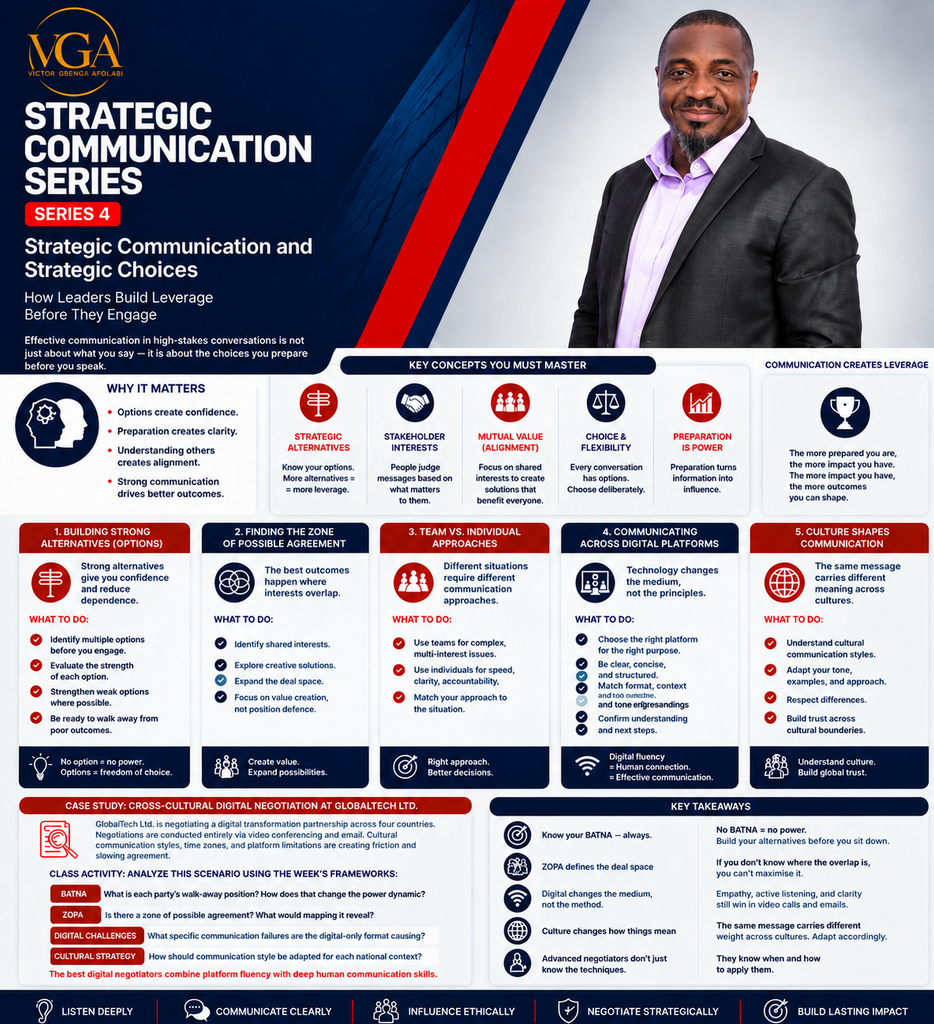
One of the greatest sources of confidence in communication is having options.
When leaders have only one possible path, their communication becomes dependent.
They communicate from a position of urgency.
They may compromise too quickly.
They may accept outcomes that do not support their long-term objectives.
However, when leaders understand their alternatives, they communicate from a position of strength.
Alternatives create flexibility.
They create confidence.
They allow leaders to make decisions based on strategy rather than pressure.
In strategic communication, the question is not only:
“What do we want to achieve?”
The question is also:
“What options exist if our preferred outcome does not happen?”
Strong leaders do not prepare only for agreement.
They prepare for possibilities.
Preparation Creates Communication Advantage
Great communication is rarely spontaneous.
Behind every effective strategic conversation is preparation.
Leaders must understand:
- What outcome are we trying to achieve?
- Who are the stakeholders involved?
- What matters to them?
- What concerns may they have?
- What information will influence their decision?
- What alternatives exist?
- What risks should be considered?
Preparation improves communication because it allows leaders to enter conversations with clarity.
Without preparation, people often react.
With preparation, people respond strategically.
The difference between reaction and response is one of the defining characteristics of effective leadership communication.
Understanding Stakeholder Interests Creates Alignment
Strategic communication is not only about presenting your position.
It is about understanding the positions, interests, and motivations of others.
Different stakeholders often want different things.
A customer may prioritise reliability.
An investor may prioritise growth and sustainability.
An employee may prioritise stability and opportunity.
A partner may prioritise value creation and trust.
The same message may not influence all stakeholders equally because people evaluate communication through their own priorities.
This is why strategic communicators ask:
- What does this stakeholder value?
- What problem are they trying to solve?
- What outcome matters most to them?
- Where do our interests overlap?
- Where do we need to create understanding?
Communication becomes more effective when leaders move beyond stating what they want and begin understanding what others need.
Finding the Space for Mutual Value
Successful communication is rarely about one side winning and another side losing.
The strongest strategic outcomes are often created in the space where different interests overlap.
Leaders must identify:
- Where can value be created?
- What shared objectives exist?
- What adjustments can improve alignment?
- What solutions create benefits beyond the immediate discussion?
This requires creativity.
It requires listening.
It requires the ability to see beyond fixed positions.
A stakeholder may reject an initial proposal but accept a different approach that addresses their underlying concern.
Strategic communication therefore requires flexibility.
The objective is not simply to defend a position.
The objective is to create movement toward a valuable outcome.
The Power of Strategic Alternatives
Strong alternatives create confidence.
They reduce dependence.
They improve decision quality.
They also influence how leaders communicate.
A leader with alternatives can ask better questions.
They can evaluate opportunities more carefully.
They can walk away from outcomes that do not support their strategic direction.
This does not mean rejecting collaboration.
It means entering conversations with clarity.
The strongest leaders are not those who must always win every conversation.
They are those who understand when to engage, when to adapt, and when to pursue another path.
Strategic communication requires knowing that every conversation is part of a larger strategy.
Communication Across Digital Platforms Requires New Discipline
The modern leader communicates across multiple platforms.
Meetings.
Emails.
Video conferences.
Collaboration tools.
Digital communities.
Social platforms.
While technology has changed the medium, it has not changed the fundamentals of effective communication.
Trust still matters.
Clarity still matters.
Empathy still matters.
Understanding still matters.
Digital communication creates new challenges.
Tone can be misunderstood.
Context can be lost.
Cultural differences can become more visible.
Information can move faster than understanding.
Therefore, leaders must become more intentional.
A message sent through a digital platform still carries signals.
The question remains:
What are people understanding from what we communicate?
Culture Changes How Communication Is Received
The same message can create different reactions depending on the cultural context.
Communication styles differ.
Some environments value directness.
Others value relationship-building before decisions.
Some stakeholders expect detailed explanations.
Others prefer concise conclusions.
Strategic communicators understand that effectiveness is not only about delivering a message.
It is about delivering it in a way that connects with the audience receiving it.
The responsibility of the communicator is not simply to speak clearly.
It is to ensure understanding.
Team Communication and Individual Communication
Different situations require different communication approaches.
Some strategic decisions require diverse teams because complexity demands multiple perspectives.
Teams bring:
- Different expertise
- Broader analysis
- Shared responsibility
- Stronger problem-solving capability
However, individual communication can sometimes provide speed, clarity, and direct accountability.
The important question is not whether teams or individuals are better.
The question is:
What does the situation require?
Strategic leaders know when collaboration creates better outcomes and when decisive individual action is necessary.
Technology Supports Communication, But Humans Create Outcomes
Digital tools can improve communication.
They can increase access.
Improve collaboration.
Support decision-making.
Create transparency.
But technology alone does not create strategic alignment.
A video meeting does not create trust.
A collaboration platform does not create understanding.
A digital document does not create commitment.
People create those outcomes.
Technology supports communication.
Human judgement gives communication meaning.
The strongest leaders combine digital capability with emotional intelligence.
Strategic Communication Requires the Ability to Choose
Every communication decision involves choices.
What should be said?
What should not be said?
Who needs to hear it?
When should it be communicated?
Which channel is most effective?
What outcome are we trying to create?
Strategic communication is therefore not simply the ability to communicate.
It is the ability to make deliberate communication choices.
Strategic Takeaway
The strongest communicators are not simply those who speak well.
They are those who think strategically before they speak.
They understand their objectives.
They understand their stakeholders.
They understand their alternatives.
They understand the environment.
They understand that every conversation contributes to a larger strategic direction.
Before leaders attempt to influence others, they must first understand their own position.
Because communication without strategy becomes conversation.
But communication guided by strategy becomes leadership.
Every message sends a signal.
Every signal shapes perception.
Every perception influences action.
And every action contributes to the future leaders are trying to create.
Economic participation has historically depended on access to physical systems.
Access to banks, business networks, marketplaces, education institutions, and formal employment structures often determined who could participate effectively in the economy.
However, digital technology is changing how economic participation is created.
Today, a person’s ability to access opportunity is increasingly influenced by their connection to digital platforms.
Mobile payments allow small businesses to transact beyond cash limitations.
E-commerce platforms connect entrepreneurs to wider markets.
Digital learning platforms provide access to skills development.
Health technology platforms improve access to essential services.
Artificial intelligence is creating new opportunities for productivity and problem-solving.
The broader shift is clear:
Digital platforms are becoming economic infrastructure.
They are not simply tools for convenience. They are systems that determine how effectively individuals and businesses can participate in modern economies.
The Underserved Economy: A Question of Access and Connection
Across many emerging markets, millions of individuals and small businesses are economically active but remain disconnected from the systems that enable growth.
A small trader may have customers but lack digital payment options.
A skilled worker may have capability but lack access to online opportunities.
A farmer may produce valuable goods but lack market information and distribution channels.
An entrepreneur may have a viable idea but lack access to finance, training, or business networks.
The challenge is not always a lack of economic potential.
The challenge is the absence of connecting infrastructure.
Digital platforms address this gap by creating pathways between people and the systems they need to participate more effectively.
Digital Identity: Creating Economic Recognition
One of the foundations of digital inclusion is digital identity.
In traditional economic systems, many individuals struggle to access opportunities because they lack formal recognition.
Without identity systems, people may face difficulties accessing:
- Financial services
- Government programmes
- Employment opportunities
- Business platforms
- Digital transactions
Digital identity creates a foundation for participation.
It allows individuals to become visible within economic systems while enabling institutions to provide services more efficiently.
A person who was previously excluded from formal systems can now become connected to opportunities that were previously inaccessible.
Mobile Access: Expanding Economic Participation
Mobile technology has become one of the most powerful drivers of inclusion.
For many underserved communities, mobile devices represent the primary connection to the digital economy.
Through mobile platforms, individuals can:
- Access financial services
- Receive payments
- Learn new skills
- Find market opportunities
- Connect with customers
- Access information
The significance of mobile access is not only technological.
It is economic.
It reduces geographical barriers and allows more people to participate in economic activities regardless of location.
Digital Payments: Moving Beyond Cash-Based Economies
Digital payments have transformed how businesses and individuals exchange value.
For small businesses, digital payment systems create opportunities to:
- Accept more customers
- Maintain transaction records
- Build financial histories
- Access formal financial services
For individuals, digital payments provide safer and more efficient ways to participate in economic activity.
However, the impact of digital payments goes beyond transactions.
Transaction data can help create visibility for businesses that were previously invisible to formal financial systems.
This can improve access to credit, insurance, and other financial solutions.
E-Commerce: Connecting Small Businesses to Larger Markets
Many small businesses are limited not by their ability to produce, but by their ability to reach customers.
Traditional market structures often restrict businesses to their immediate geography.
Digital marketplaces change this equation.
E-commerce platforms allow entrepreneurs to:
- Reach wider customer groups
- Reduce distribution barriers
- Compete beyond local markets
- Build stronger customer relationships
This creates a more connected economy where smaller businesses can participate in larger value chains.
The opportunity is not simply selling online.
The opportunity is expanding economic reach.
Digital Skills and AI: Increasing Productivity
Access to technology alone does not guarantee inclusion.
People must also have the skills required to use digital tools effectively.
Digital literacy, online training platforms, and artificial intelligence tools are becoming increasingly important in building economic capability.
A worker with digital skills can access new employment opportunities.
A business owner using AI tools can improve efficiency.
A student with online learning access can develop capabilities beyond traditional limitations.
The future of inclusion will depend not only on connecting people to technology but ensuring they have the ability to convert technology into productivity.
Healthtech and Edtech: Digital Solutions for Essential Services
Economic participation depends on more than financial access.
People also require access to healthcare and education.
Health technology platforms are improving how individuals access medical information, consultations, and health services.
Education technology platforms are expanding access to learning opportunities, especially for people who may be limited by geography or traditional systems.
These platforms strengthen economic inclusion because healthier and more skilled populations are better positioned to contribute productively.
The Key Insight: Digital Inclusion Must Create Economic Value
A common misunderstanding is that digital inclusion simply means providing internet access or digital devices.
While connectivity is important, it is only the foundation.
The real objective is economic participation.
A successful digital inclusion system should enable people to:
- Access opportunities
- Build skills
- Create income
- Grow businesses
- Participate in markets
- Improve productivity
Technology becomes valuable when it reduces barriers and creates pathways for contribution.
Building an Integrated Digital Inclusion Ecosystem
Digital inclusion cannot be achieved through isolated solutions.
The strongest impact comes when different systems work together.
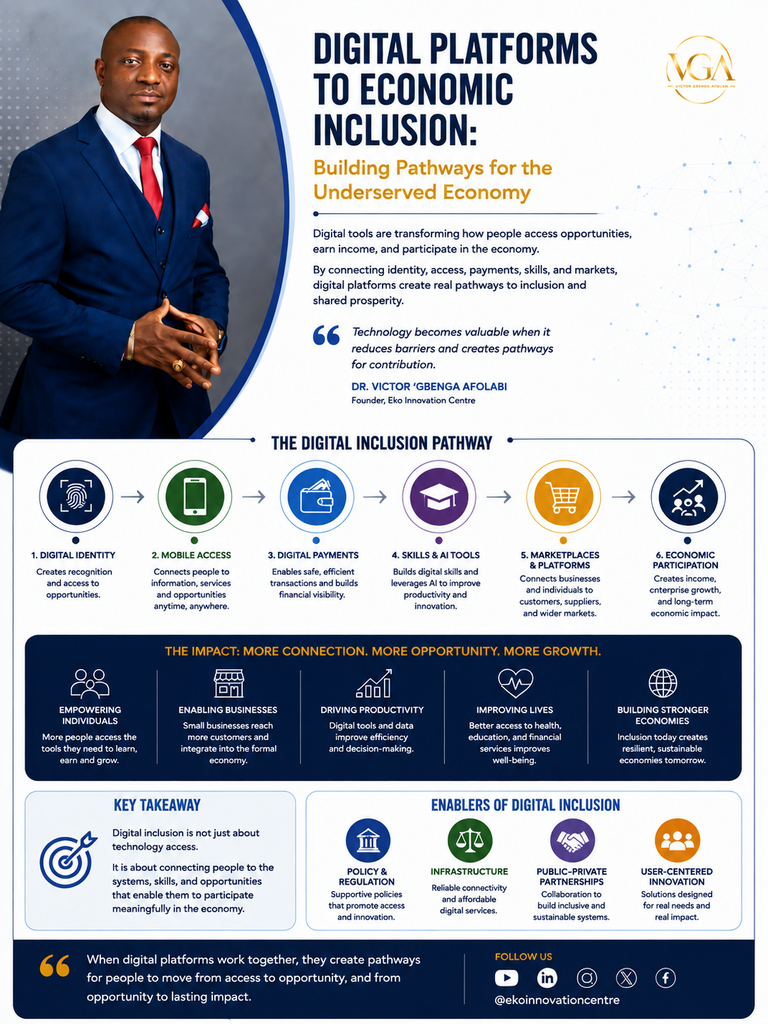
A complete digital inclusion pathway looks like this:
Digital Identity
↓
Creates recognition and access
Mobile Access
↓
Connects people to digital services
Digital Payments
↓
Enables economic transactions
Skills Development & AI Tools
↓
Improves productivity and capability
Marketplaces & Platforms
↓
Connect people to customers and opportunities
Economic Participation
↓
Creates income, enterprise growth, and productivity
This ecosystem approach transforms technology from a convenience tool into economic infrastructure.
Practical Implications for Businesses and Policymakers
For policymakers, digital inclusion should be viewed as an economic development strategy rather than only a technology initiative.
The goal should be creating systems where digital access translates into employment, enterprise growth, and productivity.
For businesses, digital platforms create opportunities to reach underserved markets, improve efficiency, and build stronger customer relationships.
For technology providers, the focus should move beyond building platforms toward solving real economic challenges.
The question is not simply:
“How many people are connected digitally?”
The more important question is:
“How many people are using digital systems to improve their economic position?”
Conclusion
Digital platforms are reshaping how economies create participation.
They are reducing barriers between individuals, businesses, and opportunities.
However, the true value of digital transformation is not measured by technology adoption alone.
It is measured by the economic outcomes created.
When digital identity, mobile access, payments, skills, marketplaces, and intelligent technologies work together, they create pathways for underserved populations to participate more effectively in the economy.
Digital inclusion is therefore not just about connecting people to technology. It is about connecting people to opportunity.
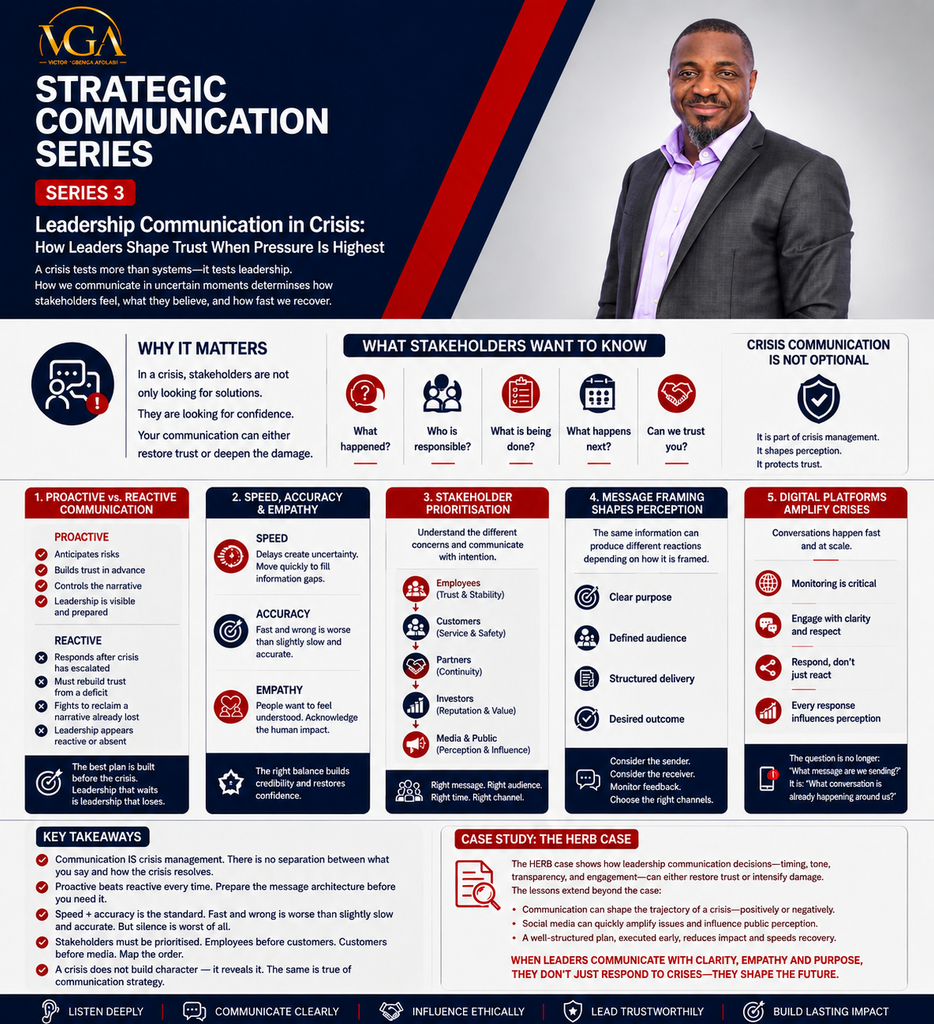
A crisis is when leadership communication matters most. When everything is stable, organisations can focus on sharing plans, celebrating progress, and reinforcing their vision. But when pressure builds, when reputation is at risk, stakeholders are anxious, and decisions must be made quickly, communication becomes more than an organisational function. It becomes a test of leadership. A crisis does not only test an organisation’s systems. It tests its judgement, values, responsiveness, and ability to maintain trust when circumstances are uncertain. The way leaders communicate during these moments can influence how quickly an organisation recovers and whether stakeholders remain confident in its direction.
Communication Is Part of Crisis Management
Many organisations treat communication as something that happens after a crisis begins. A problem emerges. Stakeholders react. Public attention increases. Then the communication team starts preparing a response. But by that point, the organisation may already be losing control of the conversation. Communication should not be treated as an activity added to crisis management. It is part of crisis management itself. When uncertainty rises, stakeholders want answers to basic questions: What happened? Who is responsible? What is being done? What happens next? Can we trust the organisation handling this situation? The answers matter, but so does the way they are delivered. A response that is slow, defensive, or unclear can deepen concern. A response that is timely, honest, and empathetic can help restore confidence.
A Crisis Reveals the Quality of Leadership
A crisis does not create leadership behaviour. It reveals it. When pressure increases, leaders cannot rely only on prepared statements or communication plans. Their decisions, tone, timing, transparency, and responsiveness all become visible. Stakeholders notice: How quickly leadership responds. Whether concerns are acknowledged. Whether the organisation accepts responsibility. Whether information is shared openly. Whether actions match words. This is why crisis communication is not simply about finding the right words. It is about ensuring that every signal from leadership reinforces trust. A leader who communicates clearly during uncertainty creates stability. A leader who avoids difficult conversations creates more uncertainty. Silence communicates. Delay communicates. Inaction communicates. The question is whether those signals are helping or harming the organisation’s ability to move forward.
The Advantage of Communicating Before a Crisis
The strongest crisis responses are usually built before the crisis begins. Proactive communication helps organisations anticipate risks, prepare stakeholders, and establish communication structures before pressure arrives. It also builds credibility. When an organisation has consistently communicated with clarity and honesty, stakeholders are more likely to give it the benefit of the doubt during difficult moments. Reactive communication is much harder. Once a situation has escalated, the organisation is no longer managing only the original problem. It is also managing speculation, public perception, information gaps, and lost confidence. A proactive organisation enters a crisis with credibility. A reactive organisation often enters one trying to rebuild credibility. Preparation gives leaders a better chance of shaping the conversation instead of simply responding to it.
Speed, Accuracy and Empathy
Effective crisis communication requires a balance between speed, accuracy, and empathy. Speed matters because information gaps create uncertainty. When organisations remain silent, other voices often fill the gap. Accuracy matters because incorrect information can damage credibility even further. Leaders must move quickly, but they must also ensure that what they share is reliable. Empathy matters because people want to feel understood. Stakeholders are not only looking for facts. They want to know that the organisation recognises the human impact of the situation. A strong crisis response therefore provides: Clear information. Timely updates. Honest acknowledgement. Practical next steps. Human understanding. Facts may explain what happened, but empathy helps people decide whether they still trust the organisation.
Different Stakeholders Need Different Answers
A crisis does not affect every stakeholder in the same way. Employees may be concerned about job security, stability, and internal trust. Customers may be concerned about safety, service, or reliability. Partners may be concerned about continuity. Investors may be concerned about reputation, performance, and long-term value. The media and wider public may influence how the situation is understood beyond the organisation itself. This is why leaders must think carefully about who needs to hear what, when, and through which channel. Before communicating, it helps to ask: Who is affected? What do they need to know? What concerns are they likely to have? What action or reassurance do they need? A single general statement may not be enough. Different audiences may require different levels of detail, tone, and follow-up. The goal is not simply to distribute information. The goal is to create understanding.
The Way a Message Is Framed Matters
The same information can produce very different reactions depending on how it is communicated. A defensive message may make an organisation appear evasive. An overly technical message may leave people confused. A vague message may create room for speculation. A clear and accountable message can help people understand both the situation and the organisation’s response.
Good crisis communication should have:
A clear purpose.
A defined audience.
A simple structure.
A realistic next step.
Leaders must think beyond what they want to say and consider what stakeholders are likely to hear.
The responsibility is not only to send information.
It is to make that information understandable, relevant, and credible.
Digital Platforms Have Changed the Crisis Conversation
The speed of digital communication has transformed the way organisations experience crises.
A customer complaint, employee comment, or public concern can spread within minutes. Stakeholders no longer wait for official statements before forming opinions. They share experiences, challenge explanations, and influence one another.
This means organisations cannot assume that they control the conversation.
They must listen as well as speak.
They need to monitor emerging concerns, identify misinformation, understand public sentiment, and respond where a response is necessary.
The question is no longer only:
“What message are we sending?”
It is also:
“What conversation is already happening around us?”
Digital platforms reward responsiveness, but they also expose inconsistency. If an organisation’s public message does not match the experience of its employees, customers, or partners, the gap can quickly become part of the crisis.
What the HERB Case Teaches Us
The HERB case demonstrates how leadership responses during public scrutiny can influence stakeholder perception.
It highlights the importance of timing, tone, transparency, accountability, and engagement.
The lesson extends beyond one organisation.
When a crisis occurs, communication becomes part of the solution. A defensive response can increase resistance, while a response that demonstrates honesty, empathy, and responsibility can help rebuild confidence.
Leaders must therefore look beyond the immediate reaction. The goal is not only to manage the current news cycle. It is to protect relationships and preserve trust over time.
Leadership Communication Requires Discipline
Crisis communication is difficult because pressure creates emotion.
Leaders may feel the need to defend themselves.
They may want to respond immediately.
They may focus only on correcting criticism.
But effective communication requires discipline.
Before responding, leaders should ask:
What outcome are we trying to achieve?
What does each stakeholder group need from us?
What message supports that outcome?
What will people understand from our response?
Do our actions support our words?
The objective is not simply to win a moment or silence criticism.
The objective is to protect relationships, reduce uncertainty, and strengthen the organisation’s ability to move forward.
Strategic Takeaway
Strategic crisis communication is not about saying everything at once or trying to control every conversation. It is about communicating with purpose, consistency, and responsibility.
Leaders should prepare before pressure arrives, respond quickly without sacrificing accuracy, acknowledge the human impact of a crisis, and tailor communication to the needs of different stakeholders.
Most importantly, leaders must ensure that their actions support their words.
Trust is built when stakeholders see clarity, accountability, empathy, and progress working together.
The Real Test of Leadership
Every decision communicates.
Every response communicates.
Every silence communicates.
Every action communicates.
The strongest leaders understand that crisis communication is not only about managing information. It is about managing trust.
A crisis does not build character.
It reveals it.
When leaders communicate with clarity, speed, empathy, and purpose, they do more than respond to challenges. They give stakeholders a reason to remain confident, even when the situation is difficult.
That is what leadership communication is ultimately about: helping people understand what is happening, believe that the organisation is acting responsibly, and see a credible path forward.
Strategic communication is not simply about having a message.
It is about possessing the communication capability required to move that message through people, relationships, institutions, and competing interests until it produces the intended outcome.
As defined earier:
“Strategic communication is the intentional use of what we say, how we say it, when we say it, and what we do as signals to both internal and external stakeholders, in a bid to execute strategic intent and shape the future we intend to lead.”
That definition places communication firmly within the execution of strategy.
But strategy cannot be executed effectively simply because the right words have been chosen.
Leaders must also know how to listen, interpret, persuade, respond, adapt, and influence.
This is where communication skill becomes strategic capability.
A leader may understand the organisation’s direction perfectly but fail to bring employees with them.
A company may have a sound proposition but fail to convince customers.
A management team may make the correct decision but communicate it so poorly that it creates resistance rather than alignment.
A business may even possess greater authority, resources, or information than another party and still fail to achieve the desired outcome because it misunderstood the human dynamics of the interaction.
The quality of strategic communication therefore depends not only on what is being communicated, but on the skills used to communicate it.
Strategic Communication Begins With Understanding People
Communication is rarely taking place between two perfectly aligned people.
Different stakeholders enter conversations with different priorities, experiences, expectations, fears, interests, and assumptions.
Employees may interpret a restructuring announcement differently from management.
Customers may judge a service failure differently from the organisation responsible for resolving it.
Investors may focus on financial sustainability while employees focus on security.
Government, business, communities, customers, and partners may all view the same strategic decision from completely different perspectives.
This makes one of the fundamental principles of strategic communication very simple:
Before attempting to influence people, understand how they see the situation.
It is not enough to know what you want them to understand.
You must first understand what they already believe.
What are they concerned about?
What matters to them?
What do they expect?
What assumptions are they making?
How do they currently perceive you?
What experience has shaped their interpretation of the situation?
Communication becomes more effective when leaders stop assuming that everyone sees reality from the same position.
The strategic communicator therefore does not begin only with a message.
The strategic communicator begins with the audience.
Active Listening Is a Strategic Capability
Listening is frequently misunderstood as the quiet period before we begin speaking again.
Strategic listening is different.
It is an active process of gathering information.
When leaders listen properly, they are not simply hearing words. They are identifying interests, concerns, expectations, emotions, contradictions, and opportunities.
This creates an important strategic advantage.
The person who speaks constantly may control the airtime.
The person who listens carefully often controls the information.
Active listening allows leaders to discover what stakeholders actually value, which may be very different from what they initially say.
A customer may complain about price when the deeper issue is trust.
An employee may resist a new process when the real concern is job security.
A partner may reject a proposal because of risk rather than because of the commercial terms.
A stakeholder may appear difficult when they simply do not believe they have been heard.
The quality of the response therefore depends on the quality of the listening that came before it.
Strategic communication becomes significantly stronger when leaders listen to understand rather than listening merely to respond.
Empathy Improves Influence
Empathy is another communication capability that is frequently mistaken for softness.
It is not.
Empathy is the ability to understand another person’s perspective sufficiently well to communicate in a way that makes sense to them.
This does not require agreement.
A leader can understand an employee’s concerns without accepting every demand.
A business can recognise a customer’s frustration without admitting to something that did not happen.
Management can understand resistance to change while still proceeding with a necessary transformation.
The value of empathy is strategic because people are more likely to engage constructively when they believe their position has been understood.
When people feel ignored, they often become more defensive.
When they feel heard, dialogue becomes easier.
Empathy therefore creates the conditions in which influence becomes possible.
Clarity Is a Leadership Responsibility
Many communication problems are not caused by disagreement.
They are caused by ambiguity.
Unclear language, vague expectations, incomplete information, and unchecked assumptions can turn relatively simple situations into unnecessary conflict.
Leaders often assume that because something was communicated, it was understood.
Those are not the same thing.
A strategic communicator therefore asks:
Was the message clear?
Could it be interpreted in more than one way?
Does the audience understand what is expected?
Have assumptions been clarified?
Do people know what happens next?
Clarity reduces uncertainty.
And uncertainty is one of the greatest sources of organisational anxiety.
When leaders communicate clearly, they reduce the space in which rumours, speculation, fear, and conflicting interpretations grow.
Communication Extends Beyond Words
Strategic communication includes what is said, but it also includes what people observe.
Tone matters.
Timing matters.
Body language matters.
Silence matters.
Speed of response matters.
Consistency between words and actions matters.
A leader may verbally communicate openness while behaving defensively when challenged.
Management may announce that employees are valued while consistently excluding them from decisions that directly affect their work.
A company may promise customer-centricity while designing processes that make customer complaints difficult to resolve.
These contradictions communicate more powerfully than formal statements.
This is why strategic communication must include signals.
Every organisational action communicates something.
Sometimes the strongest message stakeholders receive is not contained in a speech, memo, advertisement, or presentation.
It is contained in behaviour.
Why Communication Breaks Down
Communication failures tend to follow recognisable patterns.
The first is miscommunication.
Ambiguous language, incomplete explanations, different interpretations, and assumptions can create disagreement where none originally existed.
The second is emotional barriers.
Frustration, anger, anxiety, embarrassment, or fear can reduce people’s ability to process information objectively.
The third is cultural difference.
Different cultures, professions, organisations, generations, and communities may use different communication norms. Behaviour that appears direct in one context may appear disrespectful in another.
The fourth is power imbalance.
When one stakeholder possesses significantly more authority, information, resources, or leverage than another, communication can become distorted.
People may stop expressing what they actually think.
Others may become overly aggressive because they believe their position gives them control.
Both situations reduce the quality of information available for decision-making.
Strategic communicators anticipate these barriers.
They do not wait until communication has broken down before addressing them.
Persuasion Is Part of Strategic Communication
Strategic communication is ultimately concerned with movement.
Moving people from confusion to understanding.
From disagreement to alignment.
From uncertainty to confidence.
From awareness to action.
That movement often requires persuasion.
Persuasion should not be confused with manipulation.
Manipulation attempts to influence people regardless of truth, transparency, or their legitimate interests.
Ethical persuasion helps people see the logic, credibility, relevance, and value of a position clearly enough to make an informed decision.
Three classical elements remain particularly useful.
Logos is logic.
It involves evidence, facts, reasoning, analysis, and a clear explanation of why something makes sense.
Ethos is credibility.
People evaluate not only the message but also the person or institution delivering it.
Trust, reputation, expertise, consistency, and integrity all affect whether a message will be believed.
Pathos is emotion.
Human beings do not make decisions using logic alone.
Values, fears, hopes, identity, aspiration, and experience shape how people respond.
Effective strategic communication therefore combines logic, credibility, and emotional understanding.
Data without trust may fail.
Trust without evidence may be insufficient.
Evidence and credibility without emotional relevance may still leave people unmoved.
The strongest communication recognises all three.
Perception Often Determines Outcomes
One of the most valuable insights in communication is that people respond not only to reality, but to their perception of reality.
This means leaders must understand what might be called the “picture in the other person’s head.”
Before attempting to change someone’s mind, understand the mental picture from which they are operating.
How do they see the problem?
How do they see themselves?
How do they see you?
What outcome do they fear?
What outcome do they want?
What do they believe they stand to lose?
This is strategically important because two stakeholders can receive the same information and reach completely different conclusions.
Until the communicator understands those different perceptions, persuasion remains largely guesswork.
You cannot effectively influence a perspective you have never attempted to understand.
People Often Decide Before Arguments Do
Organisations frequently overestimate the power of logic.
People are undoubtedly influenced by evidence.
But they are also influenced by whether they trust you.
Whether they feel respected.
Whether they believe their interests have been considered.
Whether the communication process feels fair.
Whether previous experiences have given them confidence in your intentions.
This is why interpersonal skill matters in strategic communication.
Sometimes the strongest argument fails because the relationship is weak.
Sometimes a less technically sophisticated proposal succeeds because the stakeholders trust the people presenting it.
This does not mean relationships should replace substance.
It means substance travels through relationships.
Leaders who ignore the human dimension of communication often discover that being correct is not enough to produce alignment.
Small Steps Can Produce Strategic Movement
Not every communication objective must be achieved in one conversation.
Complex change often happens incrementally.
A major strategic transformation may require several stages of communication.
People may first need to understand why change is necessary.
Then understand what will change.
Then understand what the change means for them.
Then develop confidence in the implementation process.
Then begin acting differently.
Attempting to force all of this movement at once can create resistance.
Strategic communicators therefore understand pacing.
Small agreements create momentum.
Small demonstrations of credibility build trust.
Small behavioural changes prepare people for larger ones.
This is particularly important when communicating change, managing difficult stakeholder relationships, building coalitions, or introducing unfamiliar ideas.
Strategic communication is not only about the destination.
It is also about sequencing the journey.
Use the Stakeholder’s Own Standards
One particularly effective form of communication is to connect your argument to principles the stakeholder already accepts.
If an organisation says customer experience is a priority, recommendations can be framed against that commitment.
If leadership has publicly committed to innovation, proposals can be evaluated against that standard.
If a partner has defined transparency as one of its values, discussions can return to that principle when difficult decisions arise.
This is powerful because people find it harder to reject standards they have already accepted.
Instead of constantly introducing new arguments, strategic communicators sometimes achieve more by reminding stakeholders of their own stated commitments.
Emotional Control Protects Strategic Judgement
Strategic communication becomes most difficult precisely when it matters most.
Crisis.
Conflict.
Public criticism.
Failed expectations.
Commercial pressure.
Internal resistance.
Personal disagreement.
These situations produce emotional responses.
The danger is that emotion can begin controlling the communication.
An angry leader may say something that damages trust.
A frustrated manager may communicate defensively.
An anxious executive may concede too quickly simply to end an uncomfortable conversation.
A threatened organisation may respond publicly before it understands the situation.
Emotional discipline therefore protects strategic judgement.
The objective is not to remove emotion from communication.
It is to prevent emotion from making decisions that strategy should be making.
Composure allows leaders to choose the response most likely to advance the desired objective rather than simply responding to the discomfort of the moment.
Small Human Gestures Have Strategic Value
One of the simplest communication lessons is also one of the easiest to underestimate.
People respond to being treated like people.
Using someone’s name.
Listening without interruption.
Acknowledging effort.
Saying thank you sincerely.
Recognising frustration.
Giving someone the opportunity to explain their perspective.
Following up when you said you would.
These may appear small, but they create trust.
And trust has economic, organisational, and relational consequences.
Trust reduces friction.
It accelerates decisions.
It strengthens cooperation.
It increases openness.
It makes difficult conversations easier.
Small human gestures should therefore not be dismissed as merely polite behaviour.
In many contexts, they are part of the infrastructure through which effective communication operates.
Strategic Communication Is About Influence, Not Control
One of the important distinctions leaders must understand is the difference between influence and control.
Control depends on authority.
Influence depends on communication.
A manager can sometimes compel an employee to perform a task because the organisational hierarchy gives them authority.
But authority alone cannot guarantee commitment.
It cannot guarantee trust.
It cannot guarantee belief in the strategy.
It cannot guarantee discretionary effort.
It cannot guarantee that people will continue supporting the direction when supervision disappears.
Strategic communication therefore seeks more than compliance.
It seeks understanding, alignment, credibility, engagement, and ultimately voluntary movement towards the desired strategic direction.
This is why communication becomes increasingly important as leadership responsibility grows.
The larger the organisation, the less a leader can personally control.
The leader must increasingly influence through communication.
The Leadership Imperative
Strategic communication is not simply a communications department responsibility.
It is a leadership responsibility.
Every leader communicates strategy through decisions, language, behaviour, priorities, timing, reactions, and relationships.
People continuously interpret these signals.
What leadership celebrates communicates.
What leadership ignores communicates.
What gets funded communicates.
What gets delayed communicates.
How difficult questions are answered communicates.
How people are treated under pressure communicates.
This means leaders are communicating even when they believe they are not.
The real question is whether those signals reinforce the strategy or contradict it.
Strategic Takeaway
Strong strategic communication requires more than the ability to speak confidently.
It requires the discipline to listen.
The intelligence to understand perception.
The empathy to recognise stakeholder interests.
The clarity to reduce ambiguity.
The credibility to earn trust.
The judgement to combine logic and emotion.
The adaptability to communicate across different contexts.
And the emotional control to remain deliberate when circumstances become difficult.
Ultimately, strategic influence begins when leaders stop treating communication as the transmission of information and start treating it as part of the execution of strategy.
Because every word, action, pause, response, and signal is already communicating something.
The leadership challenge is to make sure those signals are intentionally moving stakeholders towards the future the organisation intends to lead.