



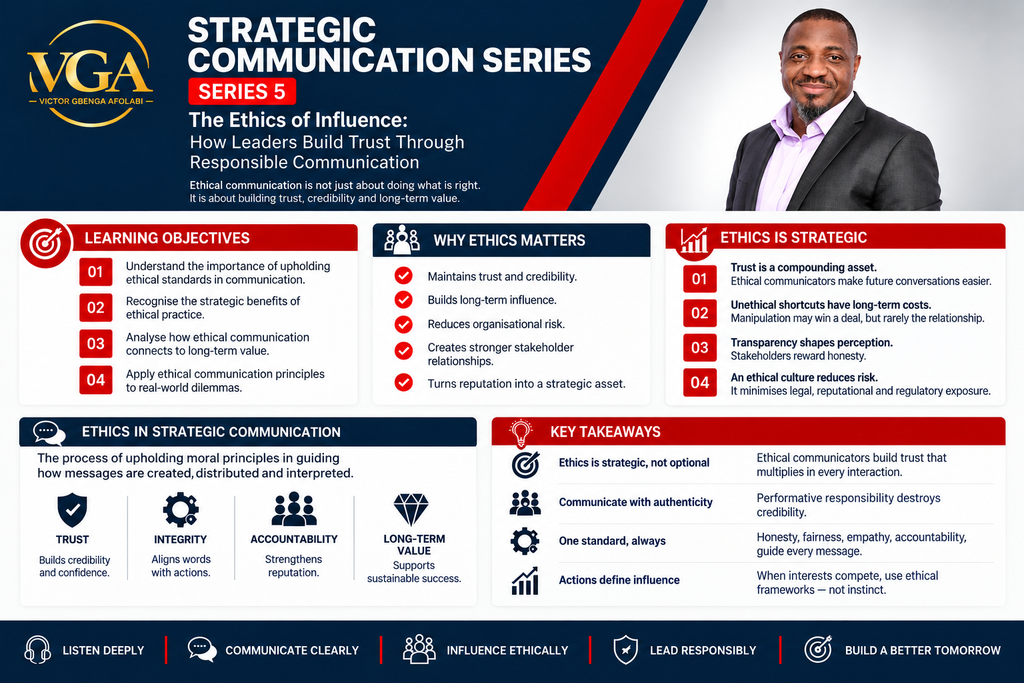
Communication is one of the most powerful tools available to leaders.
Through communication, leaders create alignment, build relationships, influence decisions, manage expectations, and shape how stakeholders understand the direction of an organisation.
But influence without ethics becomes dangerous.
The ability to persuade people does not automatically mean that the outcome created is sustainable.
A leader may win attention through exaggeration.
An organisation may attract support through carefully designed messaging.
A company may present itself as responsible through public statements.
But if those messages are not supported by truth, transparency, and consistent action, trust eventually declines.
This is why strategic communication must always be connected to ethics.
Because the goal of communication is not simply to influence people.
The goal is to influence people in a way that creates trust, credibility, and long-term value.
Ethics Is the Foundation of Strategic Communication
Strategic communication is built on one essential asset:
Trust.
Without trust, even the strongest message loses power.
Stakeholders may listen, but they will question.
They may engage, but they will hesitate.
They may participate, but they will remain uncertain.
Ethical communication strengthens trust because it demonstrates that the organisation respects the people it communicates with.
It means being intentional about:
What information is shared.
How information is presented.
What commitments are made.
How stakeholders are treated.
What actions follow the message.
Ethics is therefore not simply about doing what is morally correct.
It is also about protecting the foundation upon which relationships, partnerships, and influence are built.
Trust Is a Strategic Asset
Many organisations view trust as a reputation issue.
But trust is more than reputation.
Trust is a strategic asset.
When stakeholders believe an organisation is honest and reliable, communication becomes easier.
Partnerships become stronger.
Difficult conversations become more productive.
Future decisions become easier to execute.
Trust compounds over time.
Every ethical interaction strengthens it.
Every dishonest interaction weakens it.
This is why ethical communication creates long-term advantage.
An organisation that consistently communicates with integrity builds a reputation that supports future opportunities.
Short-Term Wins Can Create Long-Term Damage
One of the greatest mistakes leaders make is focusing only on immediate outcomes.
A misleading statement may create short-term acceptance.
A manipulated message may produce temporary support.
An exaggerated promise may attract immediate attention.
But strategic communication looks beyond the immediate moment.
The question is not only:
“Did this communication achieve the desired result today?”
The question is:
“What relationship, reputation, and trust did this communication create for tomorrow?”
Unethical communication may produce a short-term victory.
But it often creates long-term costs.
Once trust is damaged, every future message is viewed with greater suspicion.
The organisation must spend more energy proving what should have been naturally believed.
Transparency Shapes Perception
Stakeholders do not expect organisations to be perfect.
They expect organisations to be honest.
Transparency does not mean revealing everything without consideration.
It means communicating truthfully, responsibly, and with respect for stakeholders.
During uncertainty, people often judge organisations less by the existence of a problem and more by how the organisation responds to that problem.
A transparent organisation acknowledges reality.
It explains decisions.
It communicates expectations.
It accepts responsibility when necessary.
This creates confidence.
The absence of transparency creates space for assumptions, speculation, and distrust.
Strategic Communication Requires Authenticity
One of the biggest challenges facing modern organisations is the difference between what they communicate and what they actually do.
A company may communicate values such as sustainability, inclusion, responsibility, or community impact.
But stakeholders increasingly evaluate whether those values are reflected in behaviour.
This is where Corporate Social Responsibility becomes important.
CSR is not simply about publishing good stories.
It is about demonstrating meaningful action.
Authentic CSR communication follows a simple principle:
Actions first.
Messages second.
An organisation cannot communicate responsibility while consistently behaving irresponsibly.
The gap between communication and reality destroys credibility.
CSR Is More Than Public Relations
Many organisations approach CSR as a communication opportunity.
They highlight charitable activities.
They publish impact reports.
They share community initiatives.
But strategic CSR goes deeper.
It requires integration into how the organisation operates.
Stakeholders increasingly evaluate businesses based on:
How they treat people.
How they manage environmental impact.
How they contribute to communities.
How they demonstrate responsibility.
The future of CSR communication is not about proving that an organisation does good things occasionally.
It is about demonstrating that responsibility is part of the organisation’s identity.
Authentic CSR is not PR.
It is evidence.
Ethical Influence: Persuasion Without Manipulation
Influence is a necessary part of leadership.
Leaders must influence employees.
Businesses must influence customers.
Organisations must influence partners and communities.
The issue is not whether leaders should influence.
The issue is how they influence.
Ethical influence respects the ability of others to make informed decisions.
It uses:
Logic.
Credibility.
Emotional understanding.
Clear information.
Respect.
It does not rely on:
Deception.
False urgency.
Hidden information.
Fear-based manipulation.
Exploiting emotions.
The strongest influence does not remove people’s ability to choose.
It helps people understand enough to make better decisions.
The Principles of Ethical Communication
Ethical strategic communication is guided by several principles.
Honesty and Transparency
Say what is true.
Provide relevant information.
Avoid creating false impressions.
Trust begins when stakeholders believe they are receiving accurate information.
Fairness and Respect
Every stakeholder has interests that deserve consideration.
Strong communication does not dismiss people simply because they hold different views.
Accountability
Leaders must take responsibility for their words and commitments.
Communication creates expectations.
Those expectations must be honoured.
Respect for Autonomy
Influence should never become manipulation.
People should be able to make decisions based on understanding, not pressure.
Empathy and Active Listening
Effective communication requires understanding what matters to others.
Listening is not simply a technique.
It is a demonstration of respect.
Ethical Use of Influence
Persuasion should create understanding, not deception.
The objective is alignment, not control.
Confidentiality and Trust
Information shared in confidence carries responsibility.
Protecting trust means respecting boundaries.
Ethical Communication During Difficult Decisions
Leadership is often tested when interests compete.
A business decision may affect employees, investors, customers, communities, and other stakeholders differently.
There may not always be an option that satisfies everyone.
However, ethical communication determines how leaders manage those moments.
The question is not only:
“What decision are we making?”
The question is also:
“How are we communicating that decision?”
Leaders must consider:
Who is affected?
What concerns exist?
How can the decision be explained honestly?
What responsibilities must be acknowledged?
How can trust be protected?
The quality of leadership is often revealed not when decisions are easy, but when decisions are difficult.
The Heartland Foods Lesson
The Heartland Foods case highlights the challenge leaders face when different stakeholder expectations compete.
A decision that may satisfy one group may create concerns for another.
Employees may focus on values and culture.
Investors may focus on financial performance.
Communities may focus on social responsibility.
Leadership must therefore consider both the decision and the communication strategy behind it.
A poorly communicated decision can damage trust even when the intention is reasonable.
A well-communicated decision demonstrates responsibility, clarity, and respect.
The lesson is clear:
Stakeholders do not only evaluate what organisations decide.
They evaluate how organisations communicate those decisions.
Strategic Takeaway
Ethical communication is not a limitation on leadership.
It is a leadership advantage.
Organisations that communicate ethically build stronger relationships.
They attract better partnerships.
They create greater stakeholder confidence.
They reduce reputational risk.
They build credibility that supports future opportunities.
The strongest leaders understand that communication is not simply about getting people to agree.
It is about creating trust strong enough to support progress.
Because influence without trust is temporary.
But influence built on integrity creates lasting impact.
Every message sends a signal.
Every signal shapes perception.
Every perception influences action.
And every action contributes to the future an organisation is trying to lead.