



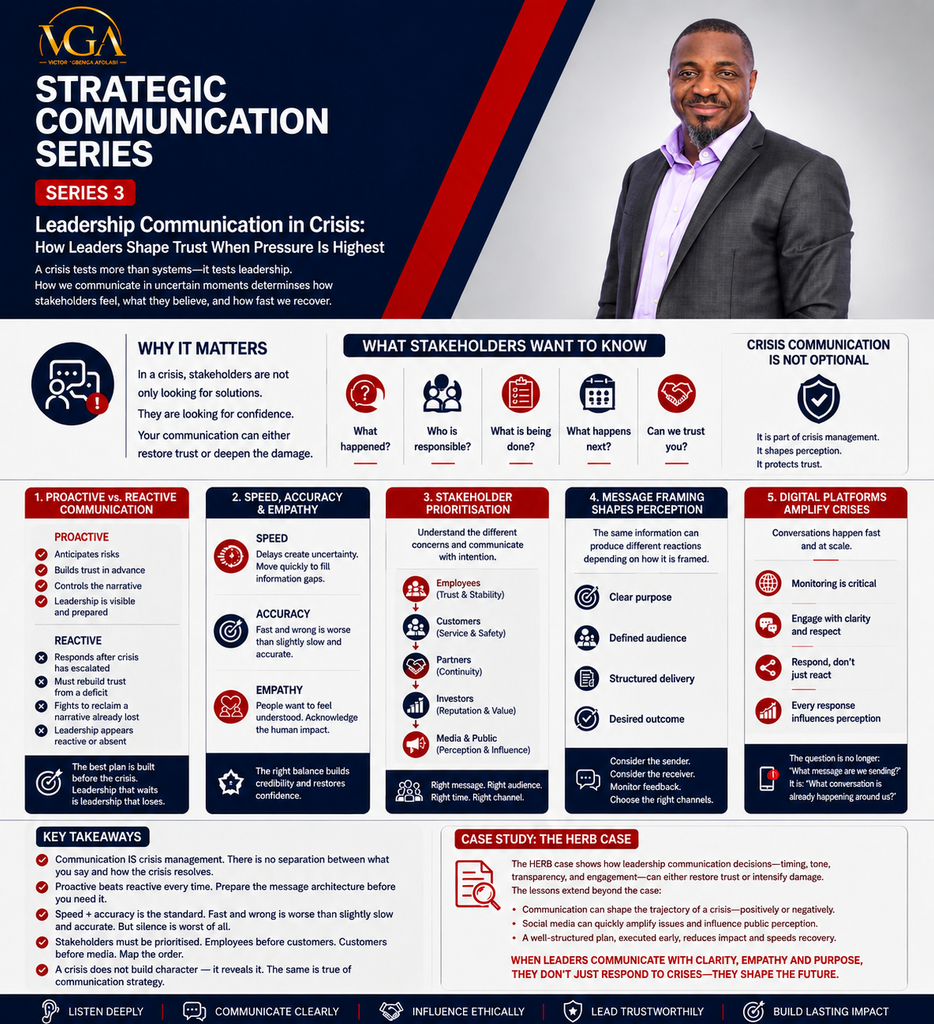
A crisis is when leadership communication matters most. When everything is stable, organisations can focus on sharing plans, celebrating progress, and reinforcing their vision. But when pressure builds, when reputation is at risk, stakeholders are anxious, and decisions must be made quickly, communication becomes more than an organisational function. It becomes a test of leadership. A crisis does not only test an organisation’s systems. It tests its judgement, values, responsiveness, and ability to maintain trust when circumstances are uncertain. The way leaders communicate during these moments can influence how quickly an organisation recovers and whether stakeholders remain confident in its direction.
Communication Is Part of Crisis Management
Many organisations treat communication as something that happens after a crisis begins. A problem emerges. Stakeholders react. Public attention increases. Then the communication team starts preparing a response. But by that point, the organisation may already be losing control of the conversation. Communication should not be treated as an activity added to crisis management. It is part of crisis management itself. When uncertainty rises, stakeholders want answers to basic questions: What happened? Who is responsible? What is being done? What happens next? Can we trust the organisation handling this situation? The answers matter, but so does the way they are delivered. A response that is slow, defensive, or unclear can deepen concern. A response that is timely, honest, and empathetic can help restore confidence.
A Crisis Reveals the Quality of Leadership
A crisis does not create leadership behaviour. It reveals it. When pressure increases, leaders cannot rely only on prepared statements or communication plans. Their decisions, tone, timing, transparency, and responsiveness all become visible. Stakeholders notice: How quickly leadership responds. Whether concerns are acknowledged. Whether the organisation accepts responsibility. Whether information is shared openly. Whether actions match words. This is why crisis communication is not simply about finding the right words. It is about ensuring that every signal from leadership reinforces trust. A leader who communicates clearly during uncertainty creates stability. A leader who avoids difficult conversations creates more uncertainty. Silence communicates. Delay communicates. Inaction communicates. The question is whether those signals are helping or harming the organisation’s ability to move forward.
The Advantage of Communicating Before a Crisis
The strongest crisis responses are usually built before the crisis begins. Proactive communication helps organisations anticipate risks, prepare stakeholders, and establish communication structures before pressure arrives. It also builds credibility. When an organisation has consistently communicated with clarity and honesty, stakeholders are more likely to give it the benefit of the doubt during difficult moments. Reactive communication is much harder. Once a situation has escalated, the organisation is no longer managing only the original problem. It is also managing speculation, public perception, information gaps, and lost confidence. A proactive organisation enters a crisis with credibility. A reactive organisation often enters one trying to rebuild credibility. Preparation gives leaders a better chance of shaping the conversation instead of simply responding to it.
Speed, Accuracy and Empathy
Effective crisis communication requires a balance between speed, accuracy, and empathy. Speed matters because information gaps create uncertainty. When organisations remain silent, other voices often fill the gap. Accuracy matters because incorrect information can damage credibility even further. Leaders must move quickly, but they must also ensure that what they share is reliable. Empathy matters because people want to feel understood. Stakeholders are not only looking for facts. They want to know that the organisation recognises the human impact of the situation. A strong crisis response therefore provides: Clear information. Timely updates. Honest acknowledgement. Practical next steps. Human understanding. Facts may explain what happened, but empathy helps people decide whether they still trust the organisation.
Different Stakeholders Need Different Answers
A crisis does not affect every stakeholder in the same way. Employees may be concerned about job security, stability, and internal trust. Customers may be concerned about safety, service, or reliability. Partners may be concerned about continuity. Investors may be concerned about reputation, performance, and long-term value. The media and wider public may influence how the situation is understood beyond the organisation itself. This is why leaders must think carefully about who needs to hear what, when, and through which channel. Before communicating, it helps to ask: Who is affected? What do they need to know? What concerns are they likely to have? What action or reassurance do they need? A single general statement may not be enough. Different audiences may require different levels of detail, tone, and follow-up. The goal is not simply to distribute information. The goal is to create understanding.
The Way a Message Is Framed Matters
The same information can produce very different reactions depending on how it is communicated. A defensive message may make an organisation appear evasive. An overly technical message may leave people confused. A vague message may create room for speculation. A clear and accountable message can help people understand both the situation and the organisation’s response.
Good crisis communication should have:
A clear purpose.
A defined audience.
A simple structure.
A realistic next step.
Leaders must think beyond what they want to say and consider what stakeholders are likely to hear.
The responsibility is not only to send information.
It is to make that information understandable, relevant, and credible.
Digital Platforms Have Changed the Crisis Conversation
The speed of digital communication has transformed the way organisations experience crises.
A customer complaint, employee comment, or public concern can spread within minutes. Stakeholders no longer wait for official statements before forming opinions. They share experiences, challenge explanations, and influence one another.
This means organisations cannot assume that they control the conversation.
They must listen as well as speak.
They need to monitor emerging concerns, identify misinformation, understand public sentiment, and respond where a response is necessary.
The question is no longer only:
“What message are we sending?”
It is also:
“What conversation is already happening around us?”
Digital platforms reward responsiveness, but they also expose inconsistency. If an organisation’s public message does not match the experience of its employees, customers, or partners, the gap can quickly become part of the crisis.
What the HERB Case Teaches Us
The HERB case demonstrates how leadership responses during public scrutiny can influence stakeholder perception.
It highlights the importance of timing, tone, transparency, accountability, and engagement.
The lesson extends beyond one organisation.
When a crisis occurs, communication becomes part of the solution. A defensive response can increase resistance, while a response that demonstrates honesty, empathy, and responsibility can help rebuild confidence.
Leaders must therefore look beyond the immediate reaction. The goal is not only to manage the current news cycle. It is to protect relationships and preserve trust over time.
Leadership Communication Requires Discipline
Crisis communication is difficult because pressure creates emotion.
Leaders may feel the need to defend themselves.
They may want to respond immediately.
They may focus only on correcting criticism.
But effective communication requires discipline.
Before responding, leaders should ask:
What outcome are we trying to achieve?
What does each stakeholder group need from us?
What message supports that outcome?
What will people understand from our response?
Do our actions support our words?
The objective is not simply to win a moment or silence criticism.
The objective is to protect relationships, reduce uncertainty, and strengthen the organisation’s ability to move forward.
Strategic Takeaway
Strategic crisis communication is not about saying everything at once or trying to control every conversation. It is about communicating with purpose, consistency, and responsibility.
Leaders should prepare before pressure arrives, respond quickly without sacrificing accuracy, acknowledge the human impact of a crisis, and tailor communication to the needs of different stakeholders.
Most importantly, leaders must ensure that their actions support their words.
Trust is built when stakeholders see clarity, accountability, empathy, and progress working together.
The Real Test of Leadership
Every decision communicates.
Every response communicates.
Every silence communicates.
Every action communicates.
The strongest leaders understand that crisis communication is not only about managing information. It is about managing trust.
A crisis does not build character.
It reveals it.
When leaders communicate with clarity, speed, empathy, and purpose, they do more than respond to challenges. They give stakeholders a reason to remain confident, even when the situation is difficult.
That is what leadership communication is ultimately about: helping people understand what is happening, believe that the organisation is acting responsibly, and see a credible path forward.