



In business, communication is never simply about passing information from one person to another. Every conversation, presentation, meeting, customer interaction, internal memo, partnership discussion, or leadership decision has the potential to influence relationships, shape perception, resolve tension, and determine outcomes.
This is what makes strategic communication different from ordinary communication.
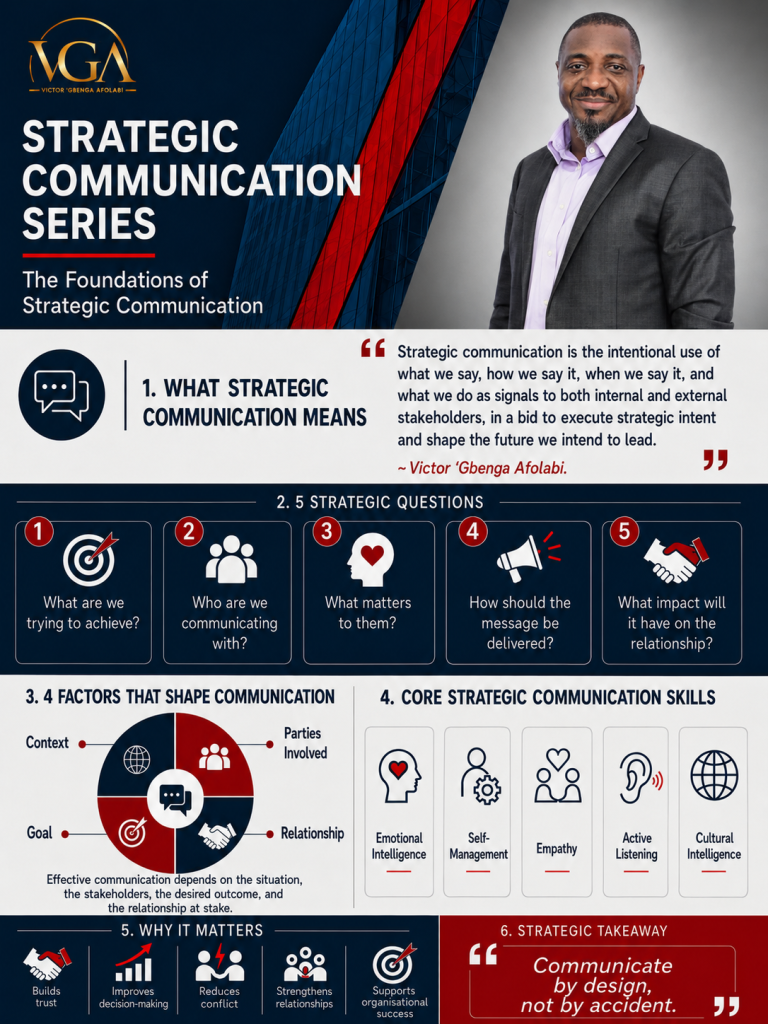
Strategic communication is the deliberate use of communication to achieve a defined objective while considering the people involved, the context of the interaction, the desired outcome, and the long-term relationship between stakeholders.
For leaders and organisations, therefore, the question is not simply, “What do we want to say?”
The more important questions are:
What are we trying to achieve?
Who are we communicating with?
What matters to them?
How should the message be delivered?
And what impact could this communication have on the relationship afterwards?
These questions form the foundation of effective strategic communication.
Communication Must Respond to Context
There is no single communication approach that works in every business situation.
The way an organisation communicates with employees during a period of change will differ from how it communicates with customers experiencing service failures. A conversation with a long-term strategic partner may require a different approach from one with a new supplier, regulator, investor, or potential client.
Effective strategic communication is therefore influenced by four major factors:
Context: What situation are we dealing with?
Parties involved: Who are the stakeholders and what are their expectations?
Goal: What outcome should the communication produce?
Relationship: What kind of relationship currently exists, and what kind of relationship do we want to maintain or build?
Understanding these factors helps leaders move away from reactive communication towards deliberate communication.
This distinction is important.
Reactive communication focuses primarily on responding to what has happened.
Strategic communication considers both the immediate situation and its wider implications for trust, reputation, relationships, and organisational objectives.
Different Situations Require Different Communication Approaches
Business interactions often involve competing interests, different expectations, cultural differences, uncertainty, and conflicting priorities.
Strategic communicators understand that some situations require collaboration, while others require firmness. Some require consensus-building. Others require listening, clarification, persuasion, mediation, or alignment among multiple stakeholders.
The objective is not to apply one communication style everywhere. It is to understand the situation well enough to choose the most effective approach.
For example, when two departments are working towards a shared organisational objective, collaborative communication may be appropriate.
Where stakeholders have conflicting priorities, an interest-based approach may be necessary, moving beyond stated positions to understand the underlying concerns influencing each party.
When several teams, organisations, or decision-makers are involved, communication becomes more complex because different interests and expectations must be managed simultaneously.
Strategic communication therefore requires adaptability.
The strongest communicators are not necessarily those who speak the most. They are those who can accurately read the environment, understand the stakeholders, select the appropriate communication approach, and move conversations towards productive outcomes.
Emotional Intelligence Is a Strategic Communication Skill
One of the most important capabilities in strategic communication is emotional intelligence.
Emotional intelligence is the ability to recognise, understand, and manage one’s own emotions while also recognising and responding appropriately to the emotions of others.
This becomes particularly important when communication involves disagreement, pressure, frustration, uncertainty, or competing interests.
A technically correct message can still fail if it is delivered without empathy.
A reasonable decision can create resistance if stakeholders feel ignored.
A customer complaint can escalate when frustration is met with defensiveness.
A partnership discussion can collapse when cultural differences or emotional concerns are dismissed.
Emotional intelligence helps prevent these outcomes because it improves communication, empathy, judgement, conflict resolution, and trust.
It allows leaders to understand that people do not respond only to information. They also respond to how that information makes them feel, whether their concerns have been acknowledged, and whether they believe they are being treated with respect.
Strategic Communication Begins With Self-Management
Before leaders can effectively manage the reactions of others, they must first manage themselves.
High-pressure business situations often trigger emotional responses. A leader may become defensive when challenged, impatient when progress is slow, or aggressive when an important objective appears threatened.
Strategic communicators recognise these emotions without allowing them to dictate their behaviour.
They create enough emotional distance to ask:
What response will produce the best outcome?
This ability to remain composed can completely change the direction of a difficult interaction.
Calmness should not be confused with weakness. In strategic communication, composure creates space for better judgement.
Empathy Changes the Quality of Communication
Empathy does not mean agreeing with every stakeholder.
It means understanding the situation from their perspective well enough to communicate effectively.
Consider a supplier that is hesitant to enter a long-term partnership because it fears becoming overly dependent on one customer.
An ineffective communicator may simply continue emphasising the benefits of the proposed arrangement.
A strategic communicator will first recognise the supplier’s concern.
The conversation then changes from:
“How do we convince them to accept our proposal?”
to:
“How do we address their underlying concern while still achieving our business objective?”
This shift is significant because it transforms communication from persuasion alone into problem-solving.
When stakeholders believe their concerns have genuinely been understood, resistance often decreases and constructive dialogue becomes easier.
Active Listening Creates Strategic Advantage
Listening is frequently treated as a passive communication activity.
It is not.
Active listening is one of the most powerful tools available to leaders.
It involves paying attention not only to what is being said but also to what may be influencing the message.
What does the stakeholder actually want?
What are they worried about?
What have they not said directly?
Where might misunderstanding exist?
What emotional signals are present?
When leaders listen at this level, communication becomes more intelligent.
They gain information that can improve decision-making, uncover hidden concerns, reduce misunderstanding, and create more effective solutions.
In complex business relationships, listening can sometimes provide more strategic advantage than speaking.
Cultural Intelligence Matters
Modern organisations increasingly operate across different industries, regions, generations, cultures, and professional backgrounds.
This creates opportunities, but it also creates communication risks.
The same message can be interpreted differently depending on culture, experience, organisational position, or expectations.
Strategic communicators recognise these differences.
Instead of assuming that another stakeholder interprets behaviour in the same way they do, they seek clarification, acknowledge differences, and adapt their communication accordingly.
This is particularly important in cross-border partnerships, multinational organisations, diverse teams, and stakeholder engagements.
Cultural awareness reduces unnecessary friction and strengthens trust.
From Customer Service to Organisational Strategy
Emotional intelligence and strategic communication should not exist only at the individual level.
Organisations must institutionalise them.
Consider a frustrated customer dealing with an airline following a service disruption.
The immediate interaction between the customer and the frontline employee matters. However, the organisation must also ask deeper questions.
Do employees have clear communication guidelines for handling highly frustrated customers?
Are staff trained to de-escalate difficult situations?
Can frontline employees make certain decisions without waiting for several layers of approval?
Does the organisation communicate transparently when service failures occur?
Are recurring customer complaints being analysed at management level?
Strategic communication therefore goes beyond teaching employees to “speak politely.”
It requires organisations to build systems that support clear, empathetic, consistent, and effective communication.
Strategic Communication Builds Long-Term Relationships
One of the greatest mistakes organisations make is evaluating communication only by whether they achieved the immediate outcome.
A conversation may produce short-term compliance while damaging a long-term relationship.
A forceful response may resolve today’s disagreement while creating tomorrow’s distrust.
Strategic communicators consider both.
They understand that sustainable business relationships depend on credibility, respect, transparency, and trust.
This does not mean every interaction must end with everyone completely satisfied.
It means stakeholders should understand the reasoning behind decisions, feel that their concerns were appropriately considered, and recognise that the process was handled professionally.
This becomes especially important when businesses must manage competing interests.
Employees may want one outcome.
Customers may want another.
Investors may have different expectations.
Management may face operational constraints.
The role of strategic communication is to help organisations navigate these competing interests without losing sight of their wider objectives.
Developing Strategic Communication Capability
Strategic communication is not simply a natural talent. It can be developed.
It requires conscious practice.
Leaders must learn to become more self-aware, listen actively, seek feedback, recognise emotional signals, understand stakeholder interests, adapt to different communication environments, and continuously evaluate the impact of their communication.
Mindfulness can improve emotional control.
Feedback can reveal communication blind spots.
Continuous learning helps leaders become more adaptable as business environments evolve.
Over time, these practices strengthen the ability to navigate increasingly complex interactions.
The Leadership Imperative
As business environments become more interconnected and stakeholder expectations become more complex, communication can no longer be treated as a soft skill.
It is a leadership capability.
A leader’s ability to communicate determines whether strategy is understood.
It affects whether employees trust leadership.
It shapes how customers experience the organisation.
It influences how partners respond to opportunities.
It affects the organisation’s ability to manage crises, resolve conflict, coordinate teams, and sustain important relationships.
Strategic communication therefore sits at the intersection of leadership, relationships, decision-making, reputation, and organisational performance.
The most effective leaders understand that communication is not simply about transmitting information.
It is about creating understanding.
It is about recognising interests.
It is about managing emotions.
It is about building trust.
And ultimately, it is about using communication intentionally to move people, relationships, and organisations towards better outcomes.
Strategic Takeaway
Every business interaction communicates something.
The strategic question is whether that communication is happening by accident or by design.
Leaders who understand context, stakeholders, objectives, relationships, emotional intelligence, empathy, and active listening are better positioned to communicate deliberately rather than reactively.
And when communication becomes deliberate, it becomes a strategic asset.