



For many years, economic inclusion has been viewed primarily as a social responsibility agenda.
Companies have often approached underserved communities through the lens of corporate social responsibility (CSR), philanthropy, or community support.
While these efforts create value, they represent only one dimension of the opportunity.
A deeper business reality is emerging:
Economic inclusion is not only a responsibility. It is a market strategy.
Across emerging economies, millions of consumers, small businesses, informal workers, and entrepreneurs remain outside traditional markets, not because they lack demand, but because existing systems were not designed around their realities.
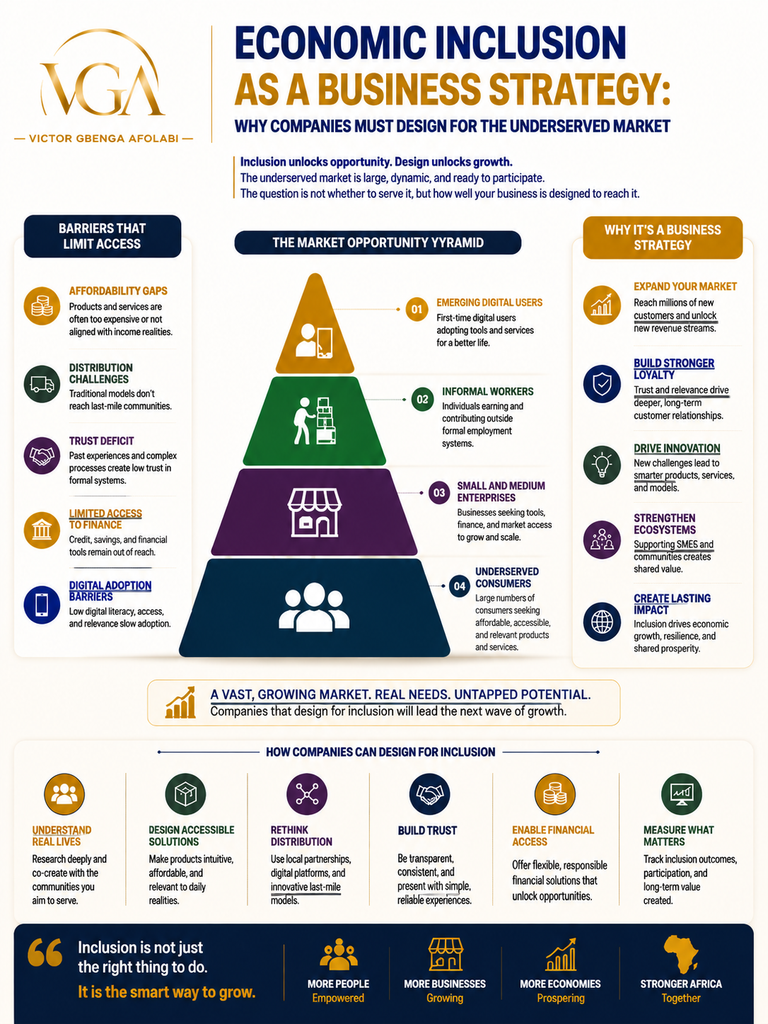
They face barriers such as:
- Limited access to affordable products and services
- Poor distribution networks
- Lack of trust in formal systems
- Limited access to finance
- Digital adoption challenges
- Products that do not reflect their income patterns or needs
For businesses, this represents more than a social challenge.
It represents a significant market opportunity.
The companies that understand how to design for underserved markets will not only expand access. They will unlock new customers, build stronger ecosystems, and create sustainable growth.
The Underserved Market Is Not a Small Market
A common misconception is that underserved consumers represent a low-value segment.
This assumption often leads businesses to overlook a large economic opportunity.
Underserved markets include:
- Informal workers
- Small business owners
- Emerging digital users
- Low-to-middle-income consumers
- Rural and semi-urban communities
These groups already participate in economic activity.
They buy products, run businesses, provide services, and create value.
The challenge is not the absence of demand.
The challenge is that many products, services, and business models are not designed to meet their realities.
Businesses that solve this design challenge can access large and growing markets.
Moving From CSR Thinking to Market Strategy
The traditional CSR approach asks:
“How can businesses support underserved communities?”
A market strategy asks a different question:
“How can businesses design solutions that enable underserved communities to participate more effectively?”
This shift changes the role of inclusion.
Instead of seeing underserved populations only as beneficiaries, businesses begin to see them as customers, partners, suppliers, and economic participants.
This requires companies to rethink:
- Product design
- Pricing structures
- Distribution models
- Customer engagement
- Financial accessibility
- Trust-building mechanisms
Inclusion becomes part of business growth rather than an activity separate from it.
Designing Products Around Real Consumer Needs
Many businesses fail to reach underserved markets because they design products based on assumptions rather than realities.
A product may be valuable, but still inaccessible because:
- The pricing does not match customer income patterns
- The payment structure is too rigid
- The product requires digital skills customers do not have
- The distribution model does not reach the customer
- The trust required to adopt the product has not been built
Successful inclusion requires customer understanding.
Companies must study how people earn, spend, save, and make decisions.
The strongest solutions are not created by lowering standards.
They are created by designing better systems.
Affordability: Creating Access Without Reducing Value
Affordability is one of the biggest factors influencing market participation.
However, affordability does not simply mean making products cheaper.
It requires understanding the economic realities of customers.
Businesses can create affordability through:
- Flexible payment structures
- Smaller product units
- Subscription models
- Asset financing solutions
- Digital payment options
The goal is not only reducing cost.
The goal is creating pathways that allow more people to access valuable products and services.
Distribution and Last-Mile Access
A major barrier in underserved markets is not demand.
It is access.
Many businesses struggle to reach customers because distribution systems are designed around major cities and established markets.
Last-mile access requires businesses to rethink how products and services move.
This may involve:
- Local partnerships
- Digital platforms
- Community-based networks
- Mobile delivery systems
- Agent models
The companies that solve distribution challenges will have a significant advantage because they can reach customers competitors overlook.
Trust as a Competitive Advantage
Trust is one of the most important elements of economic inclusion.
Many underserved consumers have limited interaction with formal institutions because previous systems may have been difficult to access or understand.
Building trust requires:
- Transparency
- Consistent service delivery
- Simple processes
- Local understanding
- Reliable customer support
Trust is not simply a social factor.
It is a business asset.
Companies that build trust within underserved communities create stronger customer relationships and long-term market loyalty.
The Role of SMEs and Informal Businesses
Small businesses and informal workers represent a significant part of many economies.
However, many remain disconnected from formal systems that support growth.
Businesses can create inclusion by designing solutions that help SMEs:
- Access finance
- Improve productivity
- Adopt technology
- Reach customers
- Strengthen operations
When SMEs grow, they create employment, increase economic activity, and strengthen local markets.
Supporting underserved businesses is therefore not only about helping individuals.
It is about strengthening the wider economic ecosystem.
The Market Opportunity Pyramid
Economic inclusion creates opportunities across multiple layers of the market:
Emerging Digital Users
People adopting digital tools and services for the first time.
↓
Informal Workers
Individuals creating economic value outside traditional systems.
↓
Small and Medium Enterprises
Businesses seeking tools, finance, and market access to scale.
↓
Underserved Consumers
Customers seeking affordable, accessible solutions.
At each level, businesses have opportunities to create value by removing barriers.
Analytical Insight: Inclusion Is a Growth Engine
The biggest misunderstanding about economic inclusion is that it reduces business profitability.
In reality, inclusion can expand markets.
When companies design for underserved customers, they often discover:
- New revenue opportunities
- Stronger customer relationships
- More resilient business models
- Improved innovation capabilities
The businesses of the future will not only compete for existing customers.
They will create systems that bring new participants into the market.
Practical Implications for Businesses
Companies seeking to design for underserved markets should consider:
1. Understand the customer reality
Move beyond assumptions and study how customers actually live, work, and make decisions.
2. Design for accessibility
Products must consider affordability, usability, and distribution.
3. Build trust intentionally
Trust should be treated as a core business strategy.
4. Use technology as an enabler
Digital tools should reduce barriers and improve access.
5. Measure participation, not only sales
The goal is not only customer acquisition but meaningful economic engagement.
Conclusion
Economic inclusion is increasingly becoming a business strategy.
The underserved market is not defined by a lack of value. It is defined by systems that have not fully enabled participation.
Companies that redesign products, services, and distribution models around these realities will discover new opportunities for growth.
The future of business growth will belong to organisations that can do more than reach existing markets.
It will belong to those that can create access, build trust, and design solutions that allow more people to participate in the economy.
Economic inclusion is not only about expanding opportunity.
It is about expanding the market itself.