A crisis is when leadership communication matters most. When everything is stable, organisations can focus on sharing plans, celebrating progress, and reinforcing their vision. But when pressure builds, when reputation is at risk, stakeholders are anxious, and decisions must be made quickly, communication becomes more than an organisational function. It becomes a test of leadership. A crisis does not only test an organisation’s systems. It tests its judgement, values, responsiveness, and ability to maintain trust when circumstances are uncertain. The way leaders communicate during these moments can influence how quickly an organisation recovers and whether stakeholders remain confident in its direction.
Communication Is Part of Crisis Management
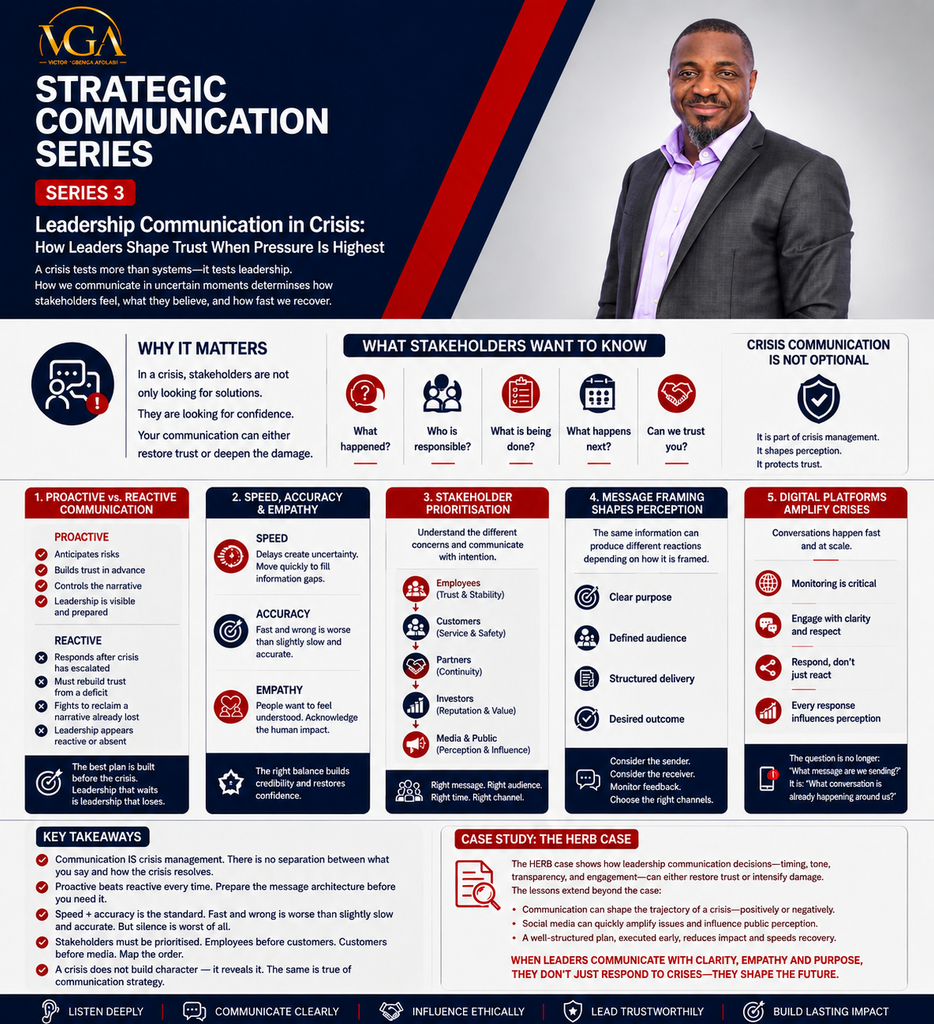
Many organisations treat communication as something that happens after a crisis begins. A problem emerges. Stakeholders react. Public attention increases. Then the communication team starts preparing a response. But by that point, the organisation may already be losing control of the conversation. Communication should not be treated as an activity added to crisis management. It is part of crisis management itself. When uncertainty rises, stakeholders want answers to basic questions: What happened? Who is responsible? What is being done? What happens next? Can we trust the organisation handling this situation? The answers matter, but so does the way they are delivered. A response that is slow, defensive, or unclear can deepen concern. A response that is timely, honest, and empathetic can help restore confidence.
A Crisis Reveals the Quality of Leadership
A crisis does not create leadership behaviour. It reveals it. When pressure increases, leaders cannot rely only on prepared statements or communication plans. Their decisions, tone, timing, transparency, and responsiveness all become visible. Stakeholders notice: How quickly leadership responds. Whether concerns are acknowledged. Whether the organisation accepts responsibility. Whether information is shared openly. Whether actions match words. This is why crisis communication is not simply about finding the right words. It is about ensuring that every signal from leadership reinforces trust. A leader who communicates clearly during uncertainty creates stability. A leader who avoids difficult conversations creates more uncertainty. Silence communicates. Delay communicates. Inaction communicates. The question is whether those signals are helping or harming the organisation’s ability to move forward.
The Advantage of Communicating Before a Crisis
The strongest crisis responses are usually built before the crisis begins. Proactive communication helps organisations anticipate risks, prepare stakeholders, and establish communication structures before pressure arrives. It also builds credibility. When an organisation has consistently communicated with clarity and honesty, stakeholders are more likely to give it the benefit of the doubt during difficult moments. Reactive communication is much harder. Once a situation has escalated, the organisation is no longer managing only the original problem. It is also managing speculation, public perception, information gaps, and lost confidence. A proactive organisation enters a crisis with credibility. A reactive organisation often enters one trying to rebuild credibility. Preparation gives leaders a better chance of shaping the conversation instead of simply responding to it.
Speed, Accuracy and Empathy
Effective crisis communication requires a balance between speed, accuracy, and empathy. Speed matters because information gaps create uncertainty. When organisations remain silent, other voices often fill the gap. Accuracy matters because incorrect information can damage credibility even further. Leaders must move quickly, but they must also ensure that what they share is reliable. Empathy matters because people want to feel understood. Stakeholders are not only looking for facts. They want to know that the organisation recognises the human impact of the situation. A strong crisis response therefore provides: Clear information. Timely updates. Honest acknowledgement. Practical next steps. Human understanding. Facts may explain what happened, but empathy helps people decide whether they still trust the organisation.
Different Stakeholders Need Different Answers
A crisis does not affect every stakeholder in the same way. Employees may be concerned about job security, stability, and internal trust. Customers may be concerned about safety, service, or reliability. Partners may be concerned about continuity. Investors may be concerned about reputation, performance, and long-term value. The media and wider public may influence how the situation is understood beyond the organisation itself. This is why leaders must think carefully about who needs to hear what, when, and through which channel. Before communicating, it helps to ask: Who is affected? What do they need to know? What concerns are they likely to have? What action or reassurance do they need? A single general statement may not be enough. Different audiences may require different levels of detail, tone, and follow-up. The goal is not simply to distribute information. The goal is to create understanding.
The Way a Message Is Framed Matters
The same information can produce very different reactions depending on how it is communicated. A defensive message may make an organisation appear evasive. An overly technical message may leave people confused. A vague message may create room for speculation. A clear and accountable message can help people understand both the situation and the organisation’s response.
Good crisis communication should have:
A clear purpose.
A defined audience.
A simple structure.
A realistic next step.
Leaders must think beyond what they want to say and consider what stakeholders are likely to hear.
The responsibility is not only to send information.
It is to make that information understandable, relevant, and credible.
Digital Platforms Have Changed the Crisis Conversation
The speed of digital communication has transformed the way organisations experience crises.
A customer complaint, employee comment, or public concern can spread within minutes. Stakeholders no longer wait for official statements before forming opinions. They share experiences, challenge explanations, and influence one another.
This means organisations cannot assume that they control the conversation.
They must listen as well as speak.
They need to monitor emerging concerns, identify misinformation, understand public sentiment, and respond where a response is necessary.
The question is no longer only:
“What message are we sending?”
It is also:
“What conversation is already happening around us?”
Digital platforms reward responsiveness, but they also expose inconsistency. If an organisation’s public message does not match the experience of its employees, customers, or partners, the gap can quickly become part of the crisis.
What the HERB Case Teaches Us
The HERB case demonstrates how leadership responses during public scrutiny can influence stakeholder perception.
It highlights the importance of timing, tone, transparency, accountability, and engagement.
The lesson extends beyond one organisation.
When a crisis occurs, communication becomes part of the solution. A defensive response can increase resistance, while a response that demonstrates honesty, empathy, and responsibility can help rebuild confidence.
Leaders must therefore look beyond the immediate reaction. The goal is not only to manage the current news cycle. It is to protect relationships and preserve trust over time.
Leadership Communication Requires Discipline
Crisis communication is difficult because pressure creates emotion.
Leaders may feel the need to defend themselves.
They may want to respond immediately.
They may focus only on correcting criticism.
But effective communication requires discipline.
Before responding, leaders should ask:
What outcome are we trying to achieve?
What does each stakeholder group need from us?
What message supports that outcome?
What will people understand from our response?
Do our actions support our words?
The objective is not simply to win a moment or silence criticism.
The objective is to protect relationships, reduce uncertainty, and strengthen the organisation’s ability to move forward.
Strategic Takeaway
Strategic crisis communication is not about saying everything at once or trying to control every conversation. It is about communicating with purpose, consistency, and responsibility.
Leaders should prepare before pressure arrives, respond quickly without sacrificing accuracy, acknowledge the human impact of a crisis, and tailor communication to the needs of different stakeholders.
Most importantly, leaders must ensure that their actions support their words.
Trust is built when stakeholders see clarity, accountability, empathy, and progress working together.
The Real Test of Leadership
Every decision communicates.
Every response communicates.
Every silence communicates.
Every action communicates.
The strongest leaders understand that crisis communication is not only about managing information. It is about managing trust.
A crisis does not build character.
It reveals it.
When leaders communicate with clarity, speed, empathy, and purpose, they do more than respond to challenges. They give stakeholders a reason to remain confident, even when the situation is difficult.
That is what leadership communication is ultimately about: helping people understand what is happening, believe that the organisation is acting responsibly, and see a credible path forward.
Communication Skills for Strategic Influence: How Listening, Perception and Persuasion Shape Outcomes
Strategic communication is not simply about having a message.
It is about possessing the communication capability required to move that message through people, relationships, institutions, and competing interests until it produces the intended outcome.
As defined earier:
“Strategic communication is the intentional use of what we say, how we say it, when we say it, and what we do as signals to both internal and external stakeholders, in a bid to execute strategic intent and shape the future we intend to lead.”
That definition places communication firmly within the execution of strategy.
But strategy cannot be executed effectively simply because the right words have been chosen.
Leaders must also know how to listen, interpret, persuade, respond, adapt, and influence.
This is where communication skill becomes strategic capability.
A leader may understand the organisation’s direction perfectly but fail to bring employees with them.
A company may have a sound proposition but fail to convince customers.
A management team may make the correct decision but communicate it so poorly that it creates resistance rather than alignment.
A business may even possess greater authority, resources, or information than another party and still fail to achieve the desired outcome because it misunderstood the human dynamics of the interaction.
The quality of strategic communication therefore depends not only on what is being communicated, but on the skills used to communicate it.
Strategic Communication Begins With Understanding People
Communication is rarely taking place between two perfectly aligned people.
Different stakeholders enter conversations with different priorities, experiences, expectations, fears, interests, and assumptions.
Employees may interpret a restructuring announcement differently from management.
Customers may judge a service failure differently from the organisation responsible for resolving it.
Investors may focus on financial sustainability while employees focus on security.
Government, business, communities, customers, and partners may all view the same strategic decision from completely different perspectives.
This makes one of the fundamental principles of strategic communication very simple:
Before attempting to influence people, understand how they see the situation.
It is not enough to know what you want them to understand.
You must first understand what they already believe.
What are they concerned about?
What matters to them?
What do they expect?
What assumptions are they making?
How do they currently perceive you?
What experience has shaped their interpretation of the situation?
Communication becomes more effective when leaders stop assuming that everyone sees reality from the same position.
The strategic communicator therefore does not begin only with a message.
The strategic communicator begins with the audience.
Active Listening Is a Strategic Capability
Listening is frequently misunderstood as the quiet period before we begin speaking again.
Strategic listening is different.
It is an active process of gathering information.
When leaders listen properly, they are not simply hearing words. They are identifying interests, concerns, expectations, emotions, contradictions, and opportunities.
This creates an important strategic advantage.
The person who speaks constantly may control the airtime.
The person who listens carefully often controls the information.
Active listening allows leaders to discover what stakeholders actually value, which may be very different from what they initially say.
A customer may complain about price when the deeper issue is trust.
An employee may resist a new process when the real concern is job security.
A partner may reject a proposal because of risk rather than because of the commercial terms.
A stakeholder may appear difficult when they simply do not believe they have been heard.
The quality of the response therefore depends on the quality of the listening that came before it.
Strategic communication becomes significantly stronger when leaders listen to understand rather than listening merely to respond.
Empathy Improves Influence
Empathy is another communication capability that is frequently mistaken for softness.
It is not.
Empathy is the ability to understand another person’s perspective sufficiently well to communicate in a way that makes sense to them.
This does not require agreement.
A leader can understand an employee’s concerns without accepting every demand.
A business can recognise a customer’s frustration without admitting to something that did not happen.
Management can understand resistance to change while still proceeding with a necessary transformation.
The value of empathy is strategic because people are more likely to engage constructively when they believe their position has been understood.
When people feel ignored, they often become more defensive.
When they feel heard, dialogue becomes easier.
Empathy therefore creates the conditions in which influence becomes possible.
Clarity Is a Leadership Responsibility
Many communication problems are not caused by disagreement.
They are caused by ambiguity.
Unclear language, vague expectations, incomplete information, and unchecked assumptions can turn relatively simple situations into unnecessary conflict.
Leaders often assume that because something was communicated, it was understood.
Those are not the same thing.
A strategic communicator therefore asks:
Was the message clear?
Could it be interpreted in more than one way?
Does the audience understand what is expected?
Have assumptions been clarified?
Do people know what happens next?
Clarity reduces uncertainty.
And uncertainty is one of the greatest sources of organisational anxiety.
When leaders communicate clearly, they reduce the space in which rumours, speculation, fear, and conflicting interpretations grow.
Communication Extends Beyond Words
Strategic communication includes what is said, but it also includes what people observe.
Tone matters.
Timing matters.
Body language matters.
Silence matters.
Speed of response matters.
Consistency between words and actions matters.
A leader may verbally communicate openness while behaving defensively when challenged.
Management may announce that employees are valued while consistently excluding them from decisions that directly affect their work.
A company may promise customer-centricity while designing processes that make customer complaints difficult to resolve.
These contradictions communicate more powerfully than formal statements.
This is why strategic communication must include signals.
Every organisational action communicates something.
Sometimes the strongest message stakeholders receive is not contained in a speech, memo, advertisement, or presentation.
It is contained in behaviour.
Why Communication Breaks Down
Communication failures tend to follow recognisable patterns.
The first is miscommunication.
Ambiguous language, incomplete explanations, different interpretations, and assumptions can create disagreement where none originally existed.
The second is emotional barriers.
Frustration, anger, anxiety, embarrassment, or fear can reduce people’s ability to process information objectively.
The third is cultural difference.
Different cultures, professions, organisations, generations, and communities may use different communication norms. Behaviour that appears direct in one context may appear disrespectful in another.
The fourth is power imbalance.
When one stakeholder possesses significantly more authority, information, resources, or leverage than another, communication can become distorted.
People may stop expressing what they actually think.
Others may become overly aggressive because they believe their position gives them control.
Both situations reduce the quality of information available for decision-making.
Strategic communicators anticipate these barriers.
They do not wait until communication has broken down before addressing them.
Persuasion Is Part of Strategic Communication
Strategic communication is ultimately concerned with movement.
Moving people from confusion to understanding.
From disagreement to alignment.
From uncertainty to confidence.
From awareness to action.
That movement often requires persuasion.
Persuasion should not be confused with manipulation.
Manipulation attempts to influence people regardless of truth, transparency, or their legitimate interests.
Ethical persuasion helps people see the logic, credibility, relevance, and value of a position clearly enough to make an informed decision.
Three classical elements remain particularly useful.
Logos is logic.
It involves evidence, facts, reasoning, analysis, and a clear explanation of why something makes sense.
Ethos is credibility.
People evaluate not only the message but also the person or institution delivering it.
Trust, reputation, expertise, consistency, and integrity all affect whether a message will be believed.
Pathos is emotion.
Human beings do not make decisions using logic alone.
Values, fears, hopes, identity, aspiration, and experience shape how people respond.
Effective strategic communication therefore combines logic, credibility, and emotional understanding.
Data without trust may fail.
Trust without evidence may be insufficient.
Evidence and credibility without emotional relevance may still leave people unmoved.
The strongest communication recognises all three.
Perception Often Determines Outcomes
One of the most valuable insights in communication is that people respond not only to reality, but to their perception of reality.
This means leaders must understand what might be called the “picture in the other person’s head.”
Before attempting to change someone’s mind, understand the mental picture from which they are operating.
How do they see the problem?
How do they see themselves?
How do they see you?
What outcome do they fear?
What outcome do they want?
What do they believe they stand to lose?
This is strategically important because two stakeholders can receive the same information and reach completely different conclusions.
Until the communicator understands those different perceptions, persuasion remains largely guesswork.
You cannot effectively influence a perspective you have never attempted to understand.
People Often Decide Before Arguments Do
Organisations frequently overestimate the power of logic.
People are undoubtedly influenced by evidence.
But they are also influenced by whether they trust you.
Whether they feel respected.
Whether they believe their interests have been considered.
Whether the communication process feels fair.
Whether previous experiences have given them confidence in your intentions.
This is why interpersonal skill matters in strategic communication.
Sometimes the strongest argument fails because the relationship is weak.
Sometimes a less technically sophisticated proposal succeeds because the stakeholders trust the people presenting it.
This does not mean relationships should replace substance.
It means substance travels through relationships.
Leaders who ignore the human dimension of communication often discover that being correct is not enough to produce alignment.
Small Steps Can Produce Strategic Movement
Not every communication objective must be achieved in one conversation.
Complex change often happens incrementally.
A major strategic transformation may require several stages of communication.
People may first need to understand why change is necessary.
Then understand what will change.
Then understand what the change means for them.
Then develop confidence in the implementation process.
Then begin acting differently.
Attempting to force all of this movement at once can create resistance.
Strategic communicators therefore understand pacing.
Small agreements create momentum.
Small demonstrations of credibility build trust.
Small behavioural changes prepare people for larger ones.
This is particularly important when communicating change, managing difficult stakeholder relationships, building coalitions, or introducing unfamiliar ideas.
Strategic communication is not only about the destination.
It is also about sequencing the journey.
Use the Stakeholder’s Own Standards
One particularly effective form of communication is to connect your argument to principles the stakeholder already accepts.
If an organisation says customer experience is a priority, recommendations can be framed against that commitment.
If leadership has publicly committed to innovation, proposals can be evaluated against that standard.
If a partner has defined transparency as one of its values, discussions can return to that principle when difficult decisions arise.
This is powerful because people find it harder to reject standards they have already accepted.
Instead of constantly introducing new arguments, strategic communicators sometimes achieve more by reminding stakeholders of their own stated commitments.
Emotional Control Protects Strategic Judgement
Strategic communication becomes most difficult precisely when it matters most.
Crisis.
Conflict.
Public criticism.
Failed expectations.
Commercial pressure.
Internal resistance.
Personal disagreement.
These situations produce emotional responses.
The danger is that emotion can begin controlling the communication.
An angry leader may say something that damages trust.
A frustrated manager may communicate defensively.
An anxious executive may concede too quickly simply to end an uncomfortable conversation.
A threatened organisation may respond publicly before it understands the situation.
Emotional discipline therefore protects strategic judgement.
The objective is not to remove emotion from communication.
It is to prevent emotion from making decisions that strategy should be making.
Composure allows leaders to choose the response most likely to advance the desired objective rather than simply responding to the discomfort of the moment.
Small Human Gestures Have Strategic Value
One of the simplest communication lessons is also one of the easiest to underestimate.
People respond to being treated like people.
Using someone’s name.
Listening without interruption.
Acknowledging effort.
Saying thank you sincerely.
Recognising frustration.
Giving someone the opportunity to explain their perspective.
Following up when you said you would.
These may appear small, but they create trust.
And trust has economic, organisational, and relational consequences.
Trust reduces friction.
It accelerates decisions.
It strengthens cooperation.
It increases openness.
It makes difficult conversations easier.
Small human gestures should therefore not be dismissed as merely polite behaviour.
In many contexts, they are part of the infrastructure through which effective communication operates.
Strategic Communication Is About Influence, Not Control
One of the important distinctions leaders must understand is the difference between influence and control.
Control depends on authority.
Influence depends on communication.
A manager can sometimes compel an employee to perform a task because the organisational hierarchy gives them authority.
But authority alone cannot guarantee commitment.
It cannot guarantee trust.
It cannot guarantee belief in the strategy.
It cannot guarantee discretionary effort.
It cannot guarantee that people will continue supporting the direction when supervision disappears.
Strategic communication therefore seeks more than compliance.
It seeks understanding, alignment, credibility, engagement, and ultimately voluntary movement towards the desired strategic direction.
This is why communication becomes increasingly important as leadership responsibility grows.
The larger the organisation, the less a leader can personally control.
The leader must increasingly influence through communication.
The Leadership Imperative
Strategic communication is not simply a communications department responsibility.
It is a leadership responsibility.
Every leader communicates strategy through decisions, language, behaviour, priorities, timing, reactions, and relationships.
People continuously interpret these signals.
What leadership celebrates communicates.
What leadership ignores communicates.
What gets funded communicates.
What gets delayed communicates.
How difficult questions are answered communicates.
How people are treated under pressure communicates.
This means leaders are communicating even when they believe they are not.
The real question is whether those signals reinforce the strategy or contradict it.
Strategic Takeaway
Strong strategic communication requires more than the ability to speak confidently.
It requires the discipline to listen.
The intelligence to understand perception.
The empathy to recognise stakeholder interests.
The clarity to reduce ambiguity.
The credibility to earn trust.
The judgement to combine logic and emotion.
The adaptability to communicate across different contexts.
And the emotional control to remain deliberate when circumstances become difficult.
Ultimately, strategic influence begins when leaders stop treating communication as the transmission of information and start treating it as part of the execution of strategy.
Because every word, action, pause, response, and signal is already communicating something.
The leadership challenge is to make sure those signals are intentionally moving stakeholders towards the future the organisation intends to lead.
In business, communication is never simply about passing information from one person to another. Every conversation, presentation, meeting, customer interaction, internal memo, partnership discussion, or leadership decision has the potential to influence relationships, shape perception, resolve tension, and determine outcomes.
This is what makes strategic communication different from ordinary communication.
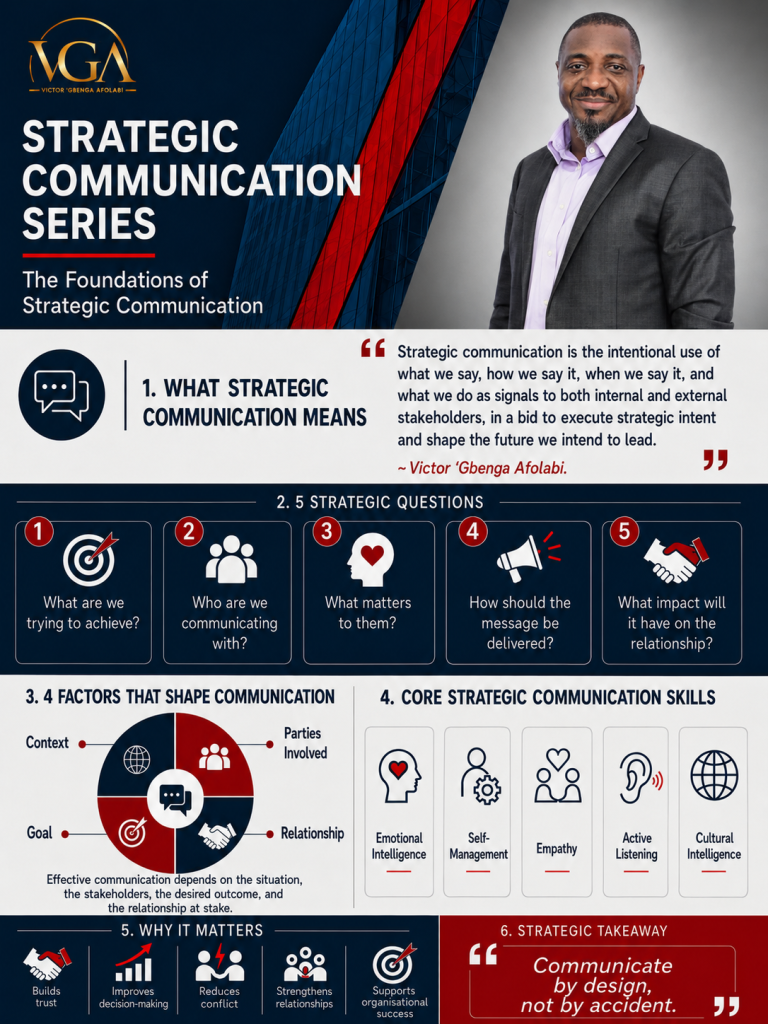
Strategic communication is the deliberate use of communication to achieve a defined objective while considering the people involved, the context of the interaction, the desired outcome, and the long-term relationship between stakeholders.
For leaders and organisations, therefore, the question is not simply, “What do we want to say?”
The more important questions are:
What are we trying to achieve?
Who are we communicating with?
What matters to them?
How should the message be delivered?
And what impact could this communication have on the relationship afterwards?
These questions form the foundation of effective strategic communication.
Communication Must Respond to Context
There is no single communication approach that works in every business situation.
The way an organisation communicates with employees during a period of change will differ from how it communicates with customers experiencing service failures. A conversation with a long-term strategic partner may require a different approach from one with a new supplier, regulator, investor, or potential client.
Effective strategic communication is therefore influenced by four major factors:
Context: What situation are we dealing with?
Parties involved: Who are the stakeholders and what are their expectations?
Goal: What outcome should the communication produce?
Relationship: What kind of relationship currently exists, and what kind of relationship do we want to maintain or build?
Understanding these factors helps leaders move away from reactive communication towards deliberate communication.
This distinction is important.
Reactive communication focuses primarily on responding to what has happened.
Strategic communication considers both the immediate situation and its wider implications for trust, reputation, relationships, and organisational objectives.
Different Situations Require Different Communication Approaches
Business interactions often involve competing interests, different expectations, cultural differences, uncertainty, and conflicting priorities.
Strategic communicators understand that some situations require collaboration, while others require firmness. Some require consensus-building. Others require listening, clarification, persuasion, mediation, or alignment among multiple stakeholders.
The objective is not to apply one communication style everywhere. It is to understand the situation well enough to choose the most effective approach.
For example, when two departments are working towards a shared organisational objective, collaborative communication may be appropriate.
Where stakeholders have conflicting priorities, an interest-based approach may be necessary, moving beyond stated positions to understand the underlying concerns influencing each party.
When several teams, organisations, or decision-makers are involved, communication becomes more complex because different interests and expectations must be managed simultaneously.
Strategic communication therefore requires adaptability.
The strongest communicators are not necessarily those who speak the most. They are those who can accurately read the environment, understand the stakeholders, select the appropriate communication approach, and move conversations towards productive outcomes.
Emotional Intelligence Is a Strategic Communication Skill
One of the most important capabilities in strategic communication is emotional intelligence.
Emotional intelligence is the ability to recognise, understand, and manage one’s own emotions while also recognising and responding appropriately to the emotions of others.
This becomes particularly important when communication involves disagreement, pressure, frustration, uncertainty, or competing interests.
A technically correct message can still fail if it is delivered without empathy.
A reasonable decision can create resistance if stakeholders feel ignored.
A customer complaint can escalate when frustration is met with defensiveness.
A partnership discussion can collapse when cultural differences or emotional concerns are dismissed.
Emotional intelligence helps prevent these outcomes because it improves communication, empathy, judgement, conflict resolution, and trust.
It allows leaders to understand that people do not respond only to information. They also respond to how that information makes them feel, whether their concerns have been acknowledged, and whether they believe they are being treated with respect.
Strategic Communication Begins With Self-Management
Before leaders can effectively manage the reactions of others, they must first manage themselves.
High-pressure business situations often trigger emotional responses. A leader may become defensive when challenged, impatient when progress is slow, or aggressive when an important objective appears threatened.
Strategic communicators recognise these emotions without allowing them to dictate their behaviour.
They create enough emotional distance to ask:
What response will produce the best outcome?
This ability to remain composed can completely change the direction of a difficult interaction.
Calmness should not be confused with weakness. In strategic communication, composure creates space for better judgement.
Empathy Changes the Quality of Communication
Empathy does not mean agreeing with every stakeholder.
It means understanding the situation from their perspective well enough to communicate effectively.
Consider a supplier that is hesitant to enter a long-term partnership because it fears becoming overly dependent on one customer.
An ineffective communicator may simply continue emphasising the benefits of the proposed arrangement.
A strategic communicator will first recognise the supplier’s concern.
The conversation then changes from:
“How do we convince them to accept our proposal?”
to:
“How do we address their underlying concern while still achieving our business objective?”
This shift is significant because it transforms communication from persuasion alone into problem-solving.
When stakeholders believe their concerns have genuinely been understood, resistance often decreases and constructive dialogue becomes easier.
Active Listening Creates Strategic Advantage
Listening is frequently treated as a passive communication activity.
It is not.
Active listening is one of the most powerful tools available to leaders.
It involves paying attention not only to what is being said but also to what may be influencing the message.
What does the stakeholder actually want?
What are they worried about?
What have they not said directly?
Where might misunderstanding exist?
What emotional signals are present?
When leaders listen at this level, communication becomes more intelligent.
They gain information that can improve decision-making, uncover hidden concerns, reduce misunderstanding, and create more effective solutions.
In complex business relationships, listening can sometimes provide more strategic advantage than speaking.
Cultural Intelligence Matters
Modern organisations increasingly operate across different industries, regions, generations, cultures, and professional backgrounds.
This creates opportunities, but it also creates communication risks.
The same message can be interpreted differently depending on culture, experience, organisational position, or expectations.
Strategic communicators recognise these differences.
Instead of assuming that another stakeholder interprets behaviour in the same way they do, they seek clarification, acknowledge differences, and adapt their communication accordingly.
This is particularly important in cross-border partnerships, multinational organisations, diverse teams, and stakeholder engagements.
Cultural awareness reduces unnecessary friction and strengthens trust.
From Customer Service to Organisational Strategy
Emotional intelligence and strategic communication should not exist only at the individual level.
Organisations must institutionalise them.
Consider a frustrated customer dealing with an airline following a service disruption.
The immediate interaction between the customer and the frontline employee matters. However, the organisation must also ask deeper questions.
Do employees have clear communication guidelines for handling highly frustrated customers?
Are staff trained to de-escalate difficult situations?
Can frontline employees make certain decisions without waiting for several layers of approval?
Does the organisation communicate transparently when service failures occur?
Are recurring customer complaints being analysed at management level?
Strategic communication therefore goes beyond teaching employees to “speak politely.”
It requires organisations to build systems that support clear, empathetic, consistent, and effective communication.
Strategic Communication Builds Long-Term Relationships
One of the greatest mistakes organisations make is evaluating communication only by whether they achieved the immediate outcome.
A conversation may produce short-term compliance while damaging a long-term relationship.
A forceful response may resolve today’s disagreement while creating tomorrow’s distrust.
Strategic communicators consider both.
They understand that sustainable business relationships depend on credibility, respect, transparency, and trust.
This does not mean every interaction must end with everyone completely satisfied.
It means stakeholders should understand the reasoning behind decisions, feel that their concerns were appropriately considered, and recognise that the process was handled professionally.
This becomes especially important when businesses must manage competing interests.
Employees may want one outcome.
Customers may want another.
Investors may have different expectations.
Management may face operational constraints.
The role of strategic communication is to help organisations navigate these competing interests without losing sight of their wider objectives.
Developing Strategic Communication Capability
Strategic communication is not simply a natural talent. It can be developed.
It requires conscious practice.
Leaders must learn to become more self-aware, listen actively, seek feedback, recognise emotional signals, understand stakeholder interests, adapt to different communication environments, and continuously evaluate the impact of their communication.
Mindfulness can improve emotional control.
Feedback can reveal communication blind spots.
Continuous learning helps leaders become more adaptable as business environments evolve.
Over time, these practices strengthen the ability to navigate increasingly complex interactions.
The Leadership Imperative
As business environments become more interconnected and stakeholder expectations become more complex, communication can no longer be treated as a soft skill.
It is a leadership capability.
A leader’s ability to communicate determines whether strategy is understood.
It affects whether employees trust leadership.
It shapes how customers experience the organisation.
It influences how partners respond to opportunities.
It affects the organisation’s ability to manage crises, resolve conflict, coordinate teams, and sustain important relationships.
Strategic communication therefore sits at the intersection of leadership, relationships, decision-making, reputation, and organisational performance.
The most effective leaders understand that communication is not simply about transmitting information.
It is about creating understanding.
It is about recognising interests.
It is about managing emotions.
It is about building trust.
And ultimately, it is about using communication intentionally to move people, relationships, and organisations towards better outcomes.
Strategic Takeaway
Every business interaction communicates something.
The strategic question is whether that communication is happening by accident or by design.
Leaders who understand context, stakeholders, objectives, relationships, emotional intelligence, empathy, and active listening are better positioned to communicate deliberately rather than reactively.
And when communication becomes deliberate, it becomes a strategic asset.

Economic inclusion is often discussed as a social intervention. In many policy conversations, it is treated as a welfare response to poverty or a moral obligation to support vulnerable populations. While this interpretation is not incorrect, it is incomplete. (https://www.econstor.eu/bitstream/10419/71821/1/736729240.pdf). At its core, economic inclusion is a productivity system. According to (Ranieri & Ramos, 2016; Timilsina et al., 2020), economic inclusion is when individuals and businesses have access to finance, skills, markets, jobs, and digital tools, they do not merely receive support; they become active contributors to national productivity. It determines how effectively a nation converts human potential into economic output. A country’s output is not shaped only by large corporations or government spending. It is also shaped by how many people are able to participate meaningfully in economic activity. Economic inclusion, therefore, is not charity. It is infrastructure (Aschauer, 1989; Timilsina et al., 2020).
Economic Inclusion as a Productivity System Economic inclusion refers to the ability of individuals, households, and businesses to access the systems required to participate in the economy (Ranieri & Ramos, 2016; Timilsina et al., 2020). These include financial services, education, skills, infrastructure, employment pathways, digital tools, and market access (https://www.econstor.eu/bitstream/10419/71821/1/736729240.pdf).
When these systems are absent, productive capacity remains dormant. A skilled worker without access to employment channels, credit, or digital infrastructure is not unemployed in isolation; they represent unused economic capacity. A small business without access to finance or distribution is not simply constrained; it is structurally underperforming (Shrestha & Bhattarai, 2025; Timilsina et al., 2020). Exclusion creates inefficiency across the system (Calderón & Servén, 2010; Cali & Mulder, 2025). It reduces income generation, limits enterprise growth, weakens demand, and slows innovation. Inclusion reverses this by expanding participation and increasing the number of active economic agents within the system. In this sense, economic inclusion is not a programme. It is an operating system for productivity.
Why Charity Cannot Replace Economic Infrastructure
Charity responds to immediate need. Economic inclusion addresses structural limitation. This distinction is critical. A welfare intervention may temporarily stabilize a household. However, it does not necessarily change the underlying economic position of that household (Timilsina et al., 2020).
Inclusion, on the other hand, aims to shift individuals from dependency to participation, and from participation to productivity. Charity is consumption-based. Economic inclusion is production-based. The objective of inclusion is not only to support people but to enable them to create value. That includes earning income, building enterprises, participating in markets, and contributing to economic output. Countries that rely solely on welfare approaches often experience recurring cycles of dependency. Countries that embed inclusion into economic infrastructure reduce long-term pressure on social systems by expanding the productive base of the economy.
Access to Finance Converts Activity Into Scale Finance is one of the most important channels of economic inclusion because it determines scale (Shrestha & Bhattarai, 2025; Timilsina et al., 2020). Many individuals already participate in economic activity but remain constrained by lack of capital. Traders cannot expand inventory. Farmers cannot invest in inputs. Small manufacturers cannot upgrade equipment. Entrepreneurs cannot scale viable ideas. Access to finance is not only a financial service issue; it is a productivity issue. When productive actors can access appropriate financial tools, they are better positioned to invest, expand operations, increase output, and participate in larger markets (https://openknowledge.worldbank.org/entities/publication/bfb41300-6823-575a-bbb1-4cec6b9bd8bf). When finance is structured properly, it becomes a multiplier. It converts existing effort into expanded output. However, it must be linked to productive activity rather than consumption alone. Otherwise, it increases financial pressure rather than economic value. Financial inclusion, therefore, is not simply about account ownership. It is about enabling economic actors to grow their productive capacity (Chen & Li, 2022; Shrestha & Bhattarai, 2025).
Skills Development Must Connect to Economic Demand Skills are central to inclusion, but only when they are connected to market realities. Training that is disconnected from economic demand produces certification without absorption. This creates a mismatch between capability and opportunity (Ranieri & Ramos, 2016; Timilsina et al., 2020). A productive skills system begins with understanding economic needs. What sectors are growing? What capabilities are required? Where are the gaps between education and employment? Skills become economically meaningful when they are connected to jobs, enterprise, and income pathways. Without this connection, skills remain theoretical rather than productive. Inclusion through skills is therefore not about training volume. It is about alignment between capability and economic demand (Chen & Li, 2022; Timilsina et al., 2020). Skills development contributes most effectively to economic growth when it aligns with labour market demand and productivity needs. Inclusion requires not only expanding access to skills but ensuring those skills translate into employment, entrepreneurship, and economic contribution (https://www.oecd.org/en/publications/the-productivity-and-equality-nexus_18d71409-en.html)
Digital Tools Expand Participation at Scale Digital infrastructure has significantly reduced the barriers to economic participation. Mobile technology, digital payments, online platforms, and cloud-based tools now allow individuals and businesses to operate with fewer physical constraints. Small enterprises can receive payments, reach customers, manage operations, and access markets beyond their immediate geography (Cali & Mulder, 2025; Timilsina et al., 2020). However, digital access alone is insufficient. Without affordability, literacy, trust systems, and reliable infrastructure, digital tools cannot translate into meaningful inclusion. True digital inclusion requires an ecosystem: connectivity, identity systems, payments, platforms, and digital literacy working together. When properly integrated, digital tools reduce the cost of participation and expand economic reach at scale (Cali & Mulder, 2025; Chen & Li, 2022).
Market Access Is the Final Link in the Inclusion Chain Inclusion only becomes economically meaningful when it leads to income generation. This depends on market access. Many small businesses fail not because they lack production capacity, but because they lack access to consistent demand. They are disconnected from buyers, distribution systems, procurement channels, and larger value chains. Market access converts capability into revenue. Without it, even skilled and financed actors remain economically constrained (Chen & Li, 2022; Shrestha & Bhattarai, 2025). This is where inclusion becomes structural. It requires systems that connect producers to buyers, workers to employers, and enterprises to scalable demand. Without market integration, inclusion remains incomplete.
Analytical Insight: What Is Commonly Misunderstood
The most common misunderstanding is that economic inclusion is primarily a social policy issue (Ranieri & Ramos, 2016). In reality, it is a productivity architecture. When large segments of a population are excluded from economic systems, the economy operates below its potential capacity. Informal businesses remain small, workers remain underutilized, and markets remain fragmented. Another misunderstanding is that inclusion can be achieved through isolated interventions. In reality, exclusion is systemic. A person may have skills but no finance. Another may have finance but no market access. Another may have demand but no infrastructure. This is why inclusion must be designed as an integrated system rather than a set of independent programmes.
Practical Implications
For policymakers, economic inclusion should be measured through productivity outcomes, not just access metrics. The key question is not how many people were reached, but how many became economically productive.
For businesses, inclusion is not philanthropy. It is market expansion. Supporting suppliers, workers, and ecosystems strengthens long-term economic capacity and demand.
For financial institutions, inclusion requires models that reflect real income structures and economic behaviour, particularly in informal and emerging sectors.
For development actors, fragmented interventions must evolve into system-level design where finance, skills, markets, and infrastructure reinforce one another.
For individuals and enterprises, inclusion requires readiness: the ability to convert access into productive activity through discipline, adaptability, and engagement with economic systems.
Conclusion
Economic inclusion is not charity. It is infrastructure through which a nation expands its productive capacity. When individuals and businesses are excluded from finance, skills, markets, and digital systems, national productivity is constrained. When they are included, the economy gains more participants, more producers, more enterprises, and more innovation capacity. The central question is not whether inclusion is socially desirable. The real question is whether any economy can sustain long-term productivity while leaving large segments of its population outside the system of value creation. Economic inclusion is therefore not a peripheral concern. It is the foundation of national productivity.